
A tiger tattoo symbolises strength, courage and protection. Across East Asia the tiger is a guardian that wards off harm, and in Western tattooing it stands for independence and a fighting spirit. What it says about you depends less on the animal than on how it is drawn: a roaring tiger and a resting one mean different things.
This guide covers the cultural meanings, including a Vietnamese tradition you can see in Hanoi’s Old Quarter, how pose changes the message, the styles that suit each reading, and the one detail that makes a tiger tattoo look like a specific animal rather than a stock image: its stripes.
What the Tiger Means in Different Cultures
| Tradition | The tiger represents | Often shown with |
| Chinese | The White Tiger (Bai Hu) is one of the Four Symbols, guardian of the west and of autumn | The Azure Dragon, as its opposite |
| Japanese | Courage and protection from bad luck and illness in irezumi | Bamboo, wind or waves; often paired against a dragon |
| Vietnamese | A protective spirit; five tigers guard the five directions in folk worship | Colour-coded tigers in folk painting |
| Hindu | Divine power under control: the goddess Durga rides a tiger | Durga, weapons, lotus |
| Western tattooing | Independence, aggression, a fighting spirit | Roses, daggers, banners |

The five tigers of Hanoi’s Old Quarter
One of the best-known Vietnamese folk images is Ngu Ho, the Five Tigers, traditionally produced as Hang Trong woodblock painting, named after a street in Hanoi’s Old Quarter. Five tigers in five colours guard the centre and four directions, and the image is associated with protection in Vietnamese folk worship.
If you are getting a tiger in Hanoi, this is a genuinely local reference rather than a borrowed Japanese one, and the bold, flat Hang Trong style translates well into tattoo linework. Our guide to Vietnamese traditional tattoo motifs covers other symbols from the same tradition.
Tiger and dragon
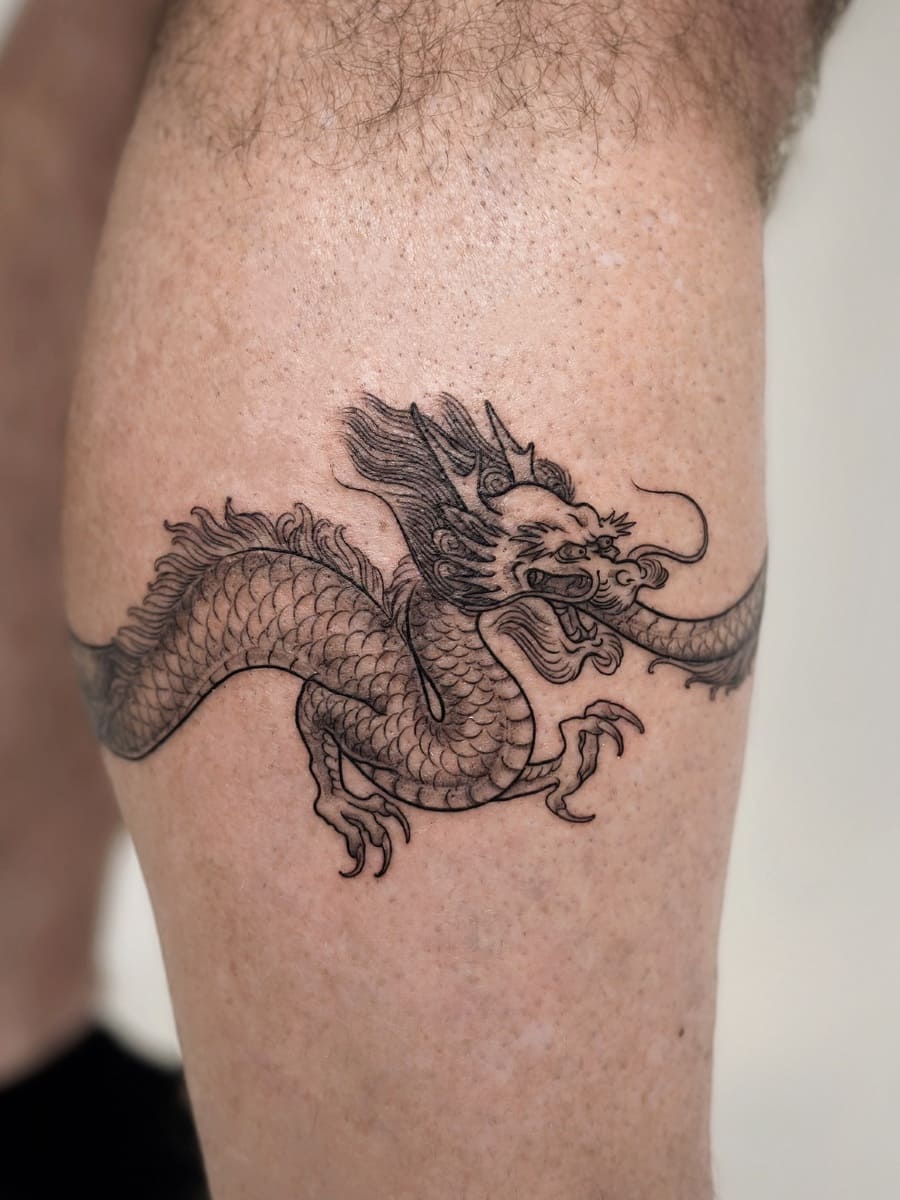
In Japanese art the tiger and the dragon are paired as opposing forces: earth against sky, physical strength against spiritual power. A tiger on one arm and a dragon on the other is a long-established way to show balance across the body.
Pose Decides the Message
| Pose | Reads as | Suits |
| Roaring or attacking | Confidence, a warning, strength in action | Chest, shoulder, upper arm |
| Crouching or stalking | Focus, strategy, power held in reserve | Thigh, ribs, side body |
| Resting or calm | Patience, maturity, strength that no longer needs proving | Forearm, back |
| Head only | Identity and intensity | Hand, shoulder, traditional flash |
| Full body in motion | A story told through movement | Spine, ribs, sleeve |
The calm tiger is the most underused of these. A roaring tiger says you are ready for a fight; a resting one says you have already had it. Many people marking the end of a hard period find the second reading more accurate.

Styles
Japanese traditional
A full-body tiger in motion, climbing or leaping, set among bamboo, wind or waves. The tiger-and-bamboo pairing is a classic of Japanese art: the bamboo bends, the tiger shelters in it. Built for sleeves and back pieces. See Asian-inspired work.
American traditional
Usually a snarling head with open jaws, thick outlines and bold colour. The most durable construction in tattooing, and one of the few tiger styles that works at a small size. See traditional work.

Realism and black and grey
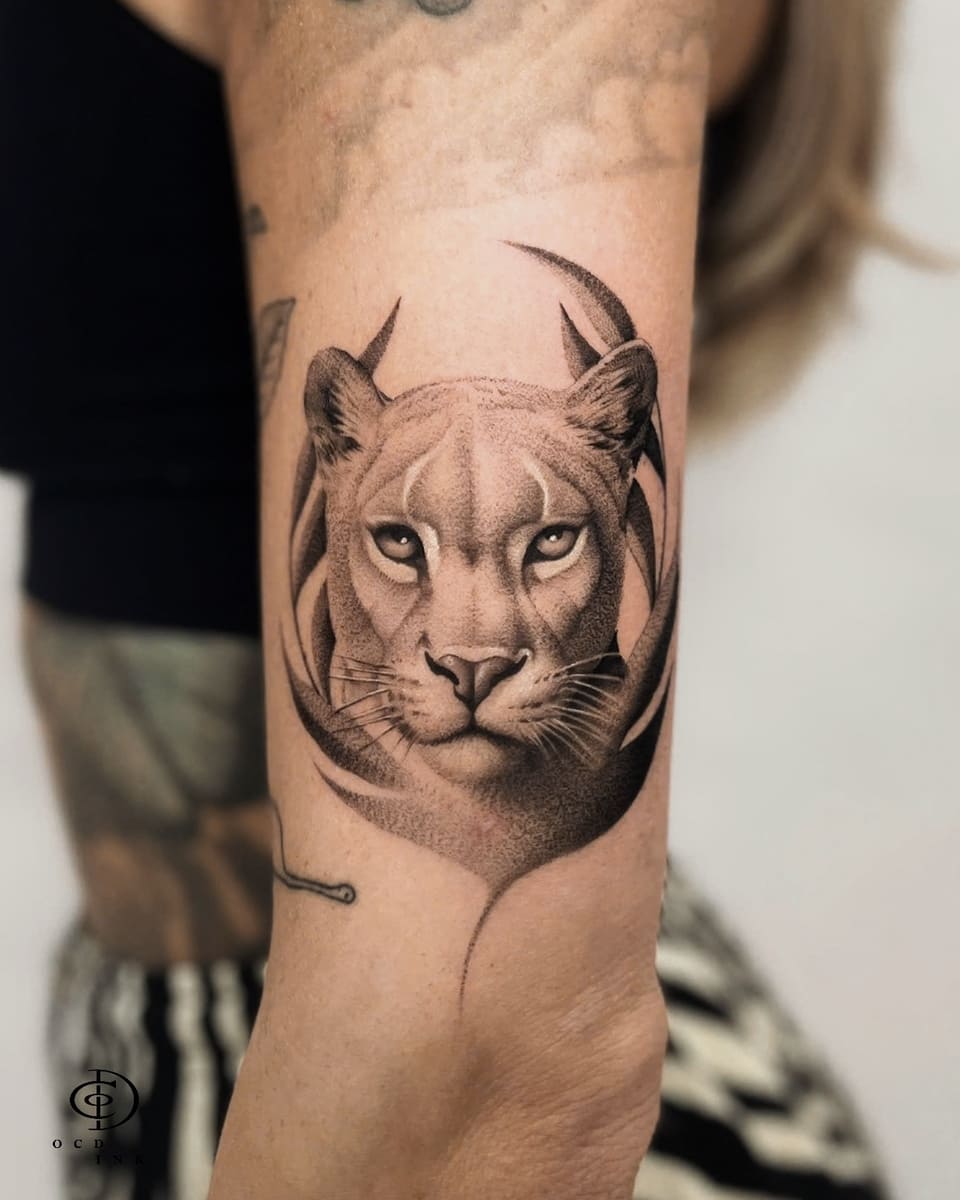
Fur texture, eye depth and a lifelike expression. The most technically demanding version and the one that most needs size. See black and grey work.

Blackwork
Solid black with the tiger carved out in negative space. The stripes become the design. Highly durable and striking at a distance. See blackwork examples.

The Stripes Are the Signature
No two tigers have the same stripe pattern; stripes are as individual as a fingerprint. That fact is worth using. A tiger tattoo traced from a stock photograph carries someone else’s tiger. One whose stripes are designed for the shape of your arm or thigh, flowing with the muscle, is yours.
Stripes also do structural work. On a curved limb, stripes that follow the contour make the animal look solid and three-dimensional; stripes copied flat from a reference make it look pasted on. This is one of the clearest differences between a custom tiger and a traced one.
How Big Does a Tiger Need to Be?
| Version | Minimum size | What fails below it |
| Traditional tiger head | 6 cm | Bold construction holds well |
| Blackwork tiger head | 7 cm | Stripe gaps close |
| Realism tiger head | 12 cm | The eyes lose depth; it reads as a generic cat |
| Full-body tiger | 20 cm | Limbs and stripes merge |
| Japanese tiger with bamboo or waves | Sleeve or back |
Ink settles slightly into surrounding skin over the years. A tiger’s face is identified by fine features around the eyes and muzzle, and those soften first, which is why a small realistic tiger tends to drift toward looking like a house cat.

Choosing a Tiger That Fits
Start with why the tiger appeals, then let that pick the pose and style rather than the other way round.
- Protection: a front-facing guardian, or the Vietnamese Five Tigers, on the chest or back.
- Survival or a hard period behind you: a calm or resting tiger in black and grey.
- Energy and confidence: a roaring traditional head on the shoulder or upper arm.
- Balance: a tiger paired with a dragon, on opposite sides of the body.

Tiger Tattoos at OCD Ink Studio
OCD Ink Studio draws every tiger for the client’s body, with stripes designed to follow the placement rather than traced from a photograph. More animal work is in our animal tattoo gallery. Four specifics:
- Artists assigned by style. Realism and colour tigers go to Mike; traditional and neo-traditional to Pillo and Sulley, who won Best Collaboration at the Saigon Tattoo Expo 2025; blackwork to Dasun. Founder Dino won Best of Day in the Black & Grey category at the Vietnam Tattoo Convention 2020.
- Healed results published openly in our healed gallery, where fur and stripe detail can be judged once settled.
- A two-year touch-up warranty, which covers settling work after healing.
- A studio in Hanoi’s Old Quarter, close to where the Five Tigers tradition comes from, and a second near Hoi An Ancient Town. See our Hanoi studio.
Send your references with a pose, size in centimetres and placement, or book in Hanoi or book in Hoi An.
FAQs
What does a tiger tattoo mean?
Strength, courage and protection. In East Asia the tiger is a guardian against harm; in Western tattooing it stands for independence and a fighting spirit.
What does a calm tiger tattoo mean?
Patience and maturity: strength that no longer needs to prove itself. It suits someone marking the end of a difficult period rather than the start of one.
What is the Vietnamese Five Tigers image?
Ngu Ho, a folk image of five coloured tigers guarding the centre and four directions, traditionally made as Hang Trong woodblock painting in Hanoi’s Old Quarter. It is associated with protection.
How big should a tiger tattoo be?
A traditional tiger head works from about 6 cm. A realistic head needs 12 cm or more, and a full-body tiger around 20 cm.
Why pair a tiger with a dragon?
In Japanese art they are opposing forces, earth and sky, physical and spiritual. Placed on opposite sides of the body, they represent balance.
How long does a tiger tattoo take?
A traditional head takes 2 to 3 hours. A realism head takes 4 to 6 hours. A Japanese full-body tiger runs across several sessions. See how long tattoos take.