
A dragon tattoo symbolises strength, wisdom and protection in East Asian tradition, and power, challenge or a guarded treasure in Western tradition. The two dragons are different creatures with different anatomy, and the one you choose decides what your tattoo says.
This guide covers the cultural meanings, how to tell Chinese, Japanese, Korean, Vietnamese and Western dragons apart by their features, the styles that suit each, and the placement decision that matters most with this subject: where the head goes.
Eastern and Western Dragons Mean Opposite Things
| East Asian dragon | Western dragon | |
| Role in myth | A benevolent force linked to water, rain and good fortune | An adversary to be overcome, or a guardian of treasure |
| Common meanings | Wisdom, protection, prosperity, rightful power | Power, danger, courage, a challenge faced |
| Body | Long and serpentine, usually wingless | Heavy, four-legged, with large bat-like wings |
| Element | Water and sky | Fire |
| Reads as | A blessing or guardian you carry | A strength you have claimed |
That difference is worth settling before anything else. A traveller who asks for “a dragon” and gets a winged, fire-breathing European beast when they wanted the protective water spirit from a temple roof has the wrong tattoo, however well it is drawn.


How to Tell Asian Dragons Apart
“Asian dragon” covers several distinct traditions. A good artist will ask which one you mean, because the details are visible to anyone who knows them.
| Tradition | Recognisable by | Associated with |
| Chinese | Five claws in imperial imagery; whiskers and a pearl often near the mouth | Imperial authority, prosperity, rain |
| Japanese | Three claws in traditional depictions; heavier, muscular body among waves and clouds | Strength, wisdom, protection; a staple of large-scale irezumi |
| Korean | Four claws in traditional depictions; often carrying an orb | Royal power, guardianship |
| Vietnamese | A slender, sinuous body in tight S-curves, drawn from Ly dynasty temple carving | Nobility, rain and agriculture, ancestral origin |
Claw counts vary between periods and artists, so treat them as convention rather than rule, but they are the detail people notice. If you are getting a dragon in Vietnam as a memory of the trip, the Vietnamese form is worth asking for by name: the default reference most artists reach for is Japanese. Our guide to Vietnamese traditional tattoo motifs explains the Ly dynasty dragon in more detail, alongside the other three sacred creatures it belongs with.
Style Changes What the Dragon Says
Japanese traditional
Bold outlines, flat colour, and the dragon set among wind bars, waves or clouds. This is the style built for large compositions, and the background is not decoration: it is what lets a long body move across a sleeve or back without floating. Expect it to be quoted per session. See Asian-inspired work for examples.

Black and grey realism
Shading builds depth into the scales and turns the body into something that appears to coil off the skin. More durable than colour and the most common choice for a dragon that should look serious rather than decorative. See black and grey work.
Fine line and linework
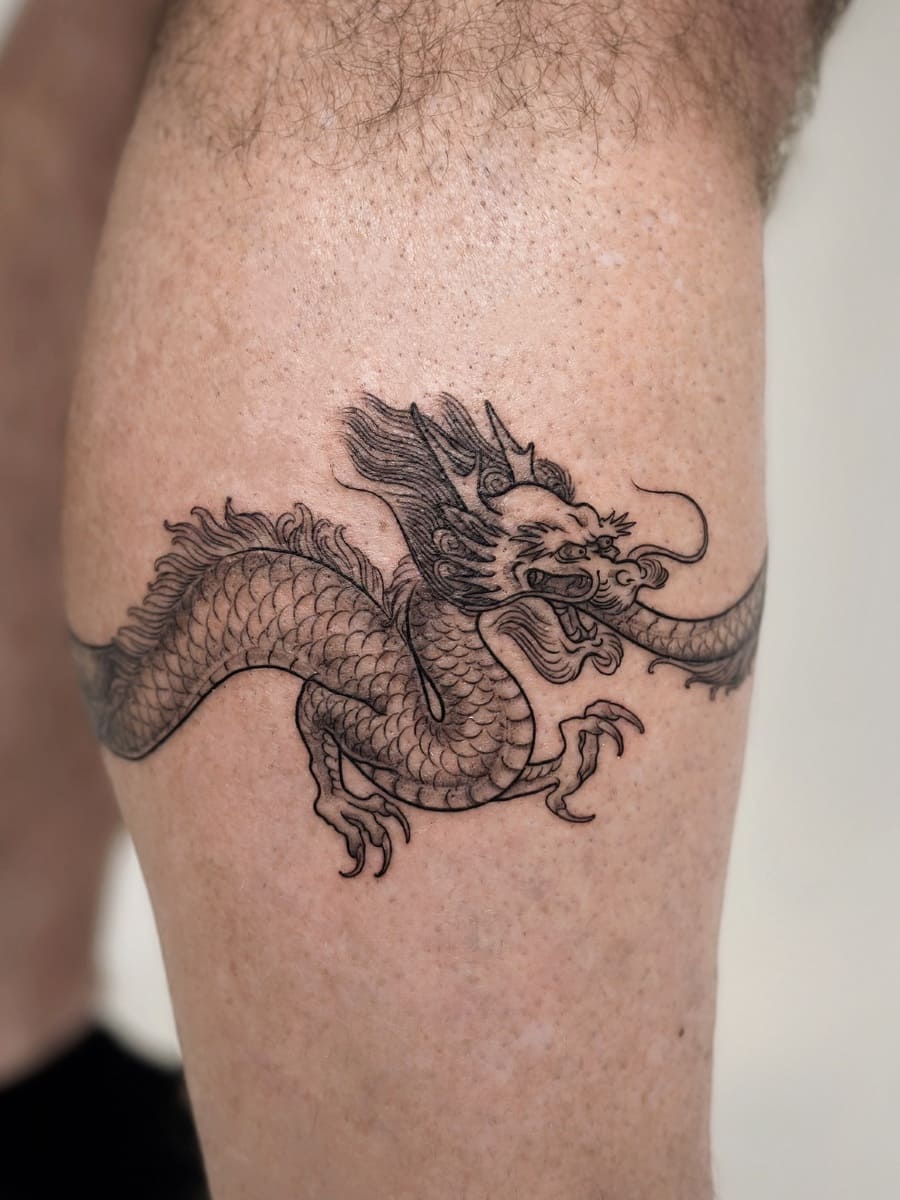
Clean, flowing lines with little or no shading. The lightest version of the subject, and the one that suits a dragon running down the spine or along the forearm. The serpentine body is naturally linear, which makes the dragon one of the few large mythical subjects that genuinely works in fine line.

Blackwork and geometric
Solid black, or the dragon built from geometric shapes. High contrast, highly durable, and the strongest choice if the piece has to read clearly from across a room. See blackwork examples.

Colour
From saturated traditional palettes to soft watercolour. Colour carries meaning in Asian dragon imagery, with gold and red tied to prosperity and blue and green to water and calm, but red and yellow pigments fade faster than black under sun. Budget for protection and the occasional refresh. See colour realism.

What a Dragon Piece Involves
Scale detail is what makes a dragon look finished, and it is slow work. The reel below follows a four-hour Asian dragon by our colour and realism artist Mike, which gives a realistic sense of the time a medium-sized dragon with full scale detail takes in the chair.
How Big Does a Dragon Need to Be?
| Version | Minimum size | What fails below it |
| Fine line silhouette | 8 cm | The head becomes an indistinct hook |
| Dragon head with whiskers and mane | 10 cm | Whiskers and teeth merge |
| Full body with visible scales | 20 cm | Scales close into a grey texture |
| Dragon with clouds or waves | Half sleeve and up | Background crowds the body |
| Traditional full composition | Full sleeve or back |
Tattoo ink settles very slightly into the surrounding skin over the years, and small, dense detail is what closes up first. If space is limited, simplify the dragon rather than shrinking a detailed one. Prices by size are in our Vietnam tattoo price guide.
Placement: Decide Where the Head Goes First
A dragon is a long, directional subject, and the head is where the eye lands. Its position decides how the whole piece reads, so it is the first placement decision, not the last.
- Head toward the front of the body. On an arm, a head facing forward reads as the dragon moving with you. A head facing backward reads as it leaving.
- Head at the top of a vertical piece. On the spine, ribs or calf, a rising dragon reads as ascent and ambition, which is the traditional reading.
- On a wrap-around piece, place the head where you can see it. A dragon coiling around the forearm with its head on the inside of the arm is a dragon you mostly see from behind.
| Placement | Suits | Notes |
| Full or half sleeve | Japanese and Chinese compositions | The arm gives the body a natural coil. See large-scale work. |
| Back | Full traditional pieces | The largest flat canvas; suits a dragon with a full background |
| Spine | Fine line or linework dragons | The serpentine body follows the spine exactly |
| Ribs and side | Vertical rising dragons | Striking, but among the more painful placements |
| Forearm | Wrap-around linework, dragon heads | Visible to you; easy to heal |
| Thigh | Large realism or colour | Spacious and naturally sun-protected |
| Wrist or ankle | Simple silhouette only | Too small for any scale or facial detail |


Choosing an Artist for a Dragon
- Ask which tradition they will draw from. An artist who asks you whether you want a Japanese, Chinese or Vietnamese dragon understands the subject.
- Look at healed scale work. Every dragon looks crisp on the day. At six weeks you can see whether the scales stayed distinct or closed into grey.
- Match the artist to the style. Traditional Japanese composition, black and grey realism and fine line are separate disciplines.
- Expect a sketch built for your body. A dragon has to follow the shape of the limb or back it sits on. A flat drawing copied onto a curved surface will look wrong.
Dragon Tattoos at OCD Ink Studio
Dragons are among the most requested subjects at OCD Ink Studio, and every one is drawn for the client’s body and placement rather than traced from flash. You can see finished pieces in our dragon tattoo gallery. Four specifics:
- Artists assigned by style. Colour and realism dragons go to Mike; fine line and graphic dragons to Dino, who won Best of Day in the Black & Grey category at the Vietnam Tattoo Convention 2020; neo-traditional work to Sulley, winner of Best Collaboration at the Saigon Tattoo Expo 2025. Full team on the artist page.
- Healed results published openly in our healed gallery, which is where scale detail can honestly be judged.
- A two-year touch-up warranty, relevant for colour dragons where gold or red may want refreshing after healing.
- Two studios on the main travel route, in Hanoi and Hoi An, with English-speaking consultation and a complimentary protective film for the first 72 hours.
Large dragons are quoted per session. If you are travelling on a fixed timeline, tell us how many days you have and we will scope a piece that can be completed and healed within it. Send your references, or book in Hanoi or book in Hoi An.
FAQs
What does a dragon tattoo symbolise?
In East Asian tradition, wisdom, protection, good fortune and rightful power. In Western tradition, power, danger and a challenge overcome. The two traditions use different creatures, so choose the dragon that matches the meaning.
How many claws should my dragon have?
By convention, five for Chinese imperial dragons, four for Korean and three for Japanese. These vary historically, but they are the details people recognise.
What does a Vietnamese dragon look like?
A slender, sinuous body in tight S-curves, drawn from Ly dynasty temple carving. It is lighter and more decorative than a Japanese dragon. Ask for it by name if you want it.
How big should a dragon tattoo be?
A fine line silhouette works from about 8 cm. A full body with visible scales needs around 20 cm, and a traditional composition with background needs a sleeve or back.
How long does a dragon tattoo take?
A small linework dragon takes 1 to 2 hours. A medium dragon with scale detail takes around 4 hours. A sleeve or back piece runs across several sessions. See how long tattoos take.
Is it disrespectful to get an Asian dragon tattoo as a foreigner?
No. The dragon is widely tattooed internationally and is not a restricted symbol. What matters is understanding which tradition you are wearing, which is why an artist who explains the differences is worth choosing.