Lotus Flower Tattoos for Men: Symbolism, Styles and Placement
The lotus reads as a masculine symbol because of what it represents, not how it is drawn: composure under pressure, discipline, and growth out of difficult conditions. The flower rises clean from muddy water, which is why it appears so often on men marking recovery, a turning point, or a long period of effort.
Design-wise, the lotus has one property that decides everything: it is radially symmetrical. That makes it forgiving to scale and unforgiving to place. This guide covers the meanings, the four style directions that suit heavier masculine work, the symmetry problem and how artists solve it, and the sizes each version needs.

What the Lotus Means
The lotus is rooted in Buddhist and Hindu symbolism, where it stands for purity, rebirth and the path toward enlightenment. It is also Vietnam’s national flower, carrying a local reading of integrity and resilience that sits alongside the wider Asian one.
| Reading | What it points to |
| Growth through difficulty | The flower rises through mud and opens clean. The most common reason men choose it. |
| Self-mastery | Composure held deliberately rather than felt naturally: control over chaos rather than absence of it. |
| Rebirth and turning points | Marking a specific change: a recovery, fatherhood, the end of a long period. |
| Order and structure | The flower’s symmetry appeals to people drawn to geometry and precision, which is why geometric treatments are so popular. |
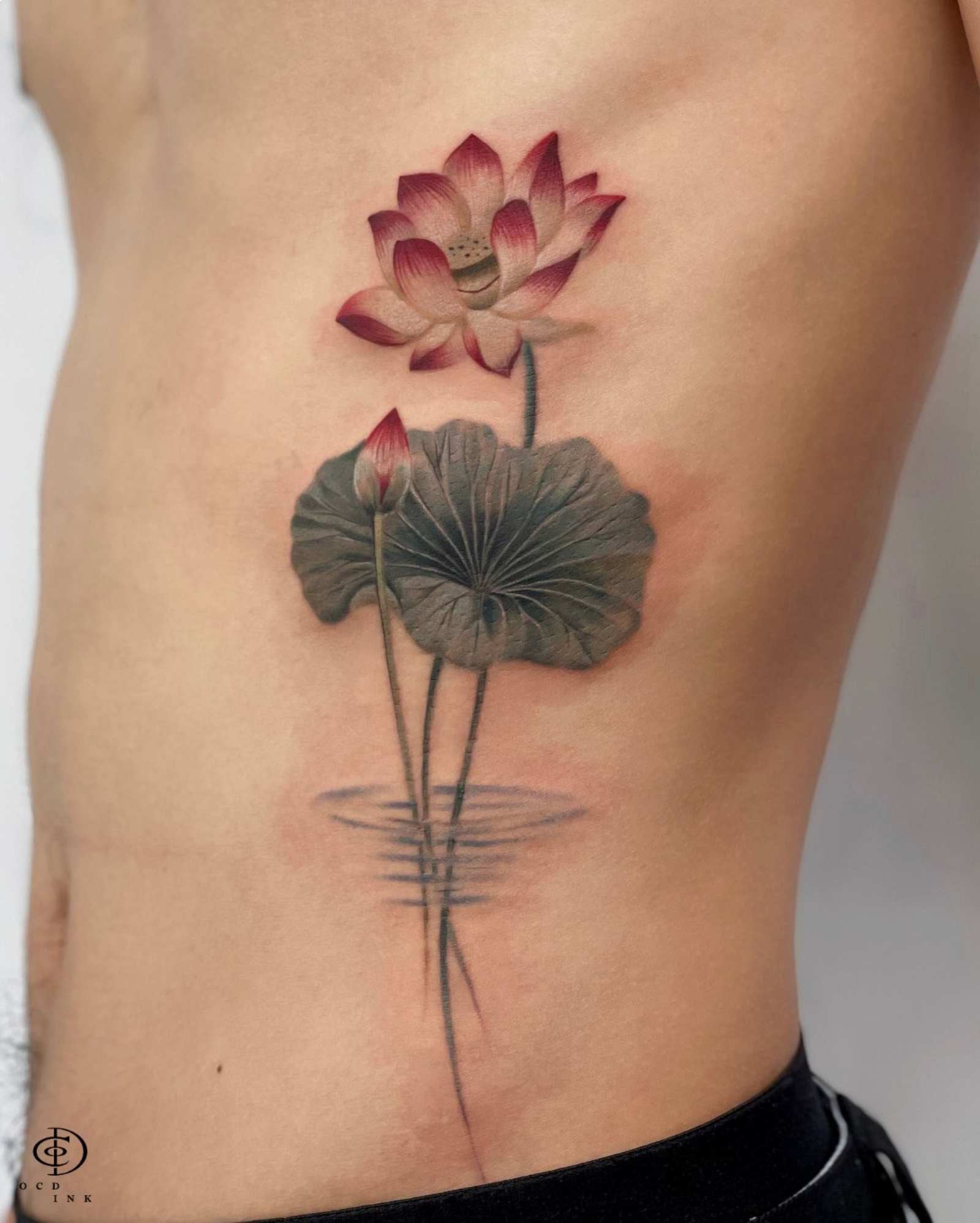
Colour carries meaning too, and it is worth deciding deliberately rather than by default. White is associated with spiritual purity, pink with devotion, blue with wisdom and control over the senses, and red with the heart and compassion. In practice most masculine lotus work is done in black and grey, which sidesteps the colour question entirely and is more durable.
The Symmetry Problem
This is the design detail that decides whether a lotus tattoo looks intentional or slightly off, and it is rarely mentioned.
A lotus is radially symmetrical, so the human eye immediately registers any deviation from centre. Bodies are not symmetrical and do not present flat surfaces. A perfectly symmetrical stencil applied to a curved forearm, a sloping chest, or an off-centre spine will photograph as crooked forever, even when the drawing itself was correct.
Two things follow from this:
- Stencil placement deserves real time. Expect several repositions, checked standing rather than lying down, and checked in a mirror by you as well as by the artist. This is the stage to be fussy about. Once it is in the skin, a two-degree tilt is permanent.
- Experienced artists often build in a deliberate asymmetry so the flower sits correctly on a curved surface rather than being geometrically perfect on paper. If your artist proposes this, it is a sign of competence rather than carelessness.
This is also why centre-line placements such as the sternum and spine are the highest-risk and highest-reward spots for a lotus. Done well they are striking; done carelessly they are the one tattoo you notice being crooked every time you look in a mirror.
Four Style Directions
Geometric and linework
Sharp lines, clean angles and a structural reading of the flower rather than a naturalistic one. The most popular masculine treatment, because it converts a soft subject into something architectural without losing the symbolism.
The technical demand here is line consistency. Geometric work exposes any wobble or variation in needle depth far more than organic shading does, which puts it squarely in fine line and graphic territory rather than with a generalist.

Dotwork and mandala
The lotus built from stippled dots, often set inside a mandala frame. Depth comes from dot density rather than from shading, which gives a distinctive texture and ages well because there are no gradients to flatten.
Worth knowing before you commit: dotwork is slow. A mandala lotus that looks similar in size to a shaded one can take two or three times as long, because every dot is placed individually. Budget the time and the session accordingly.
Japanese traditional
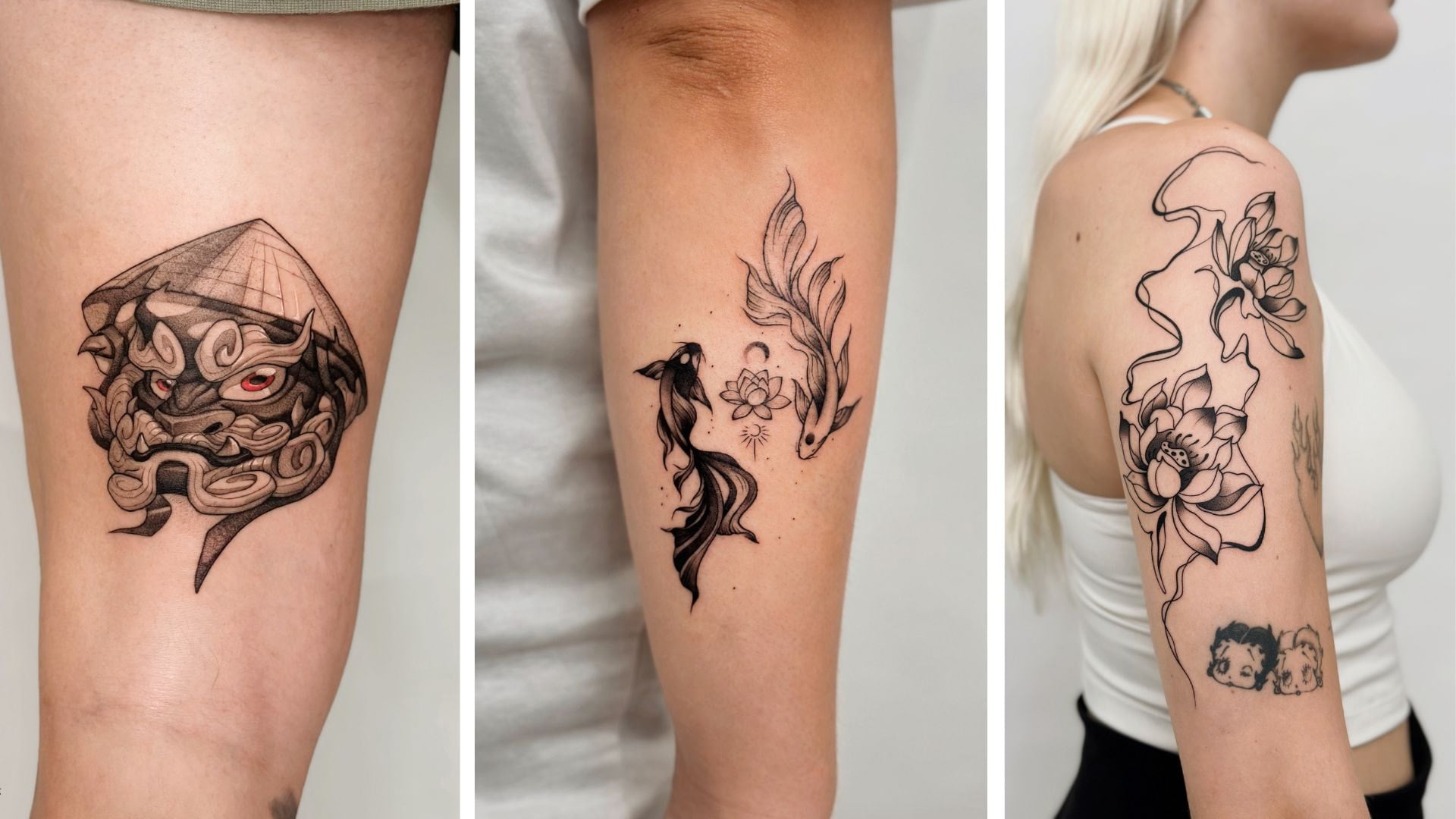
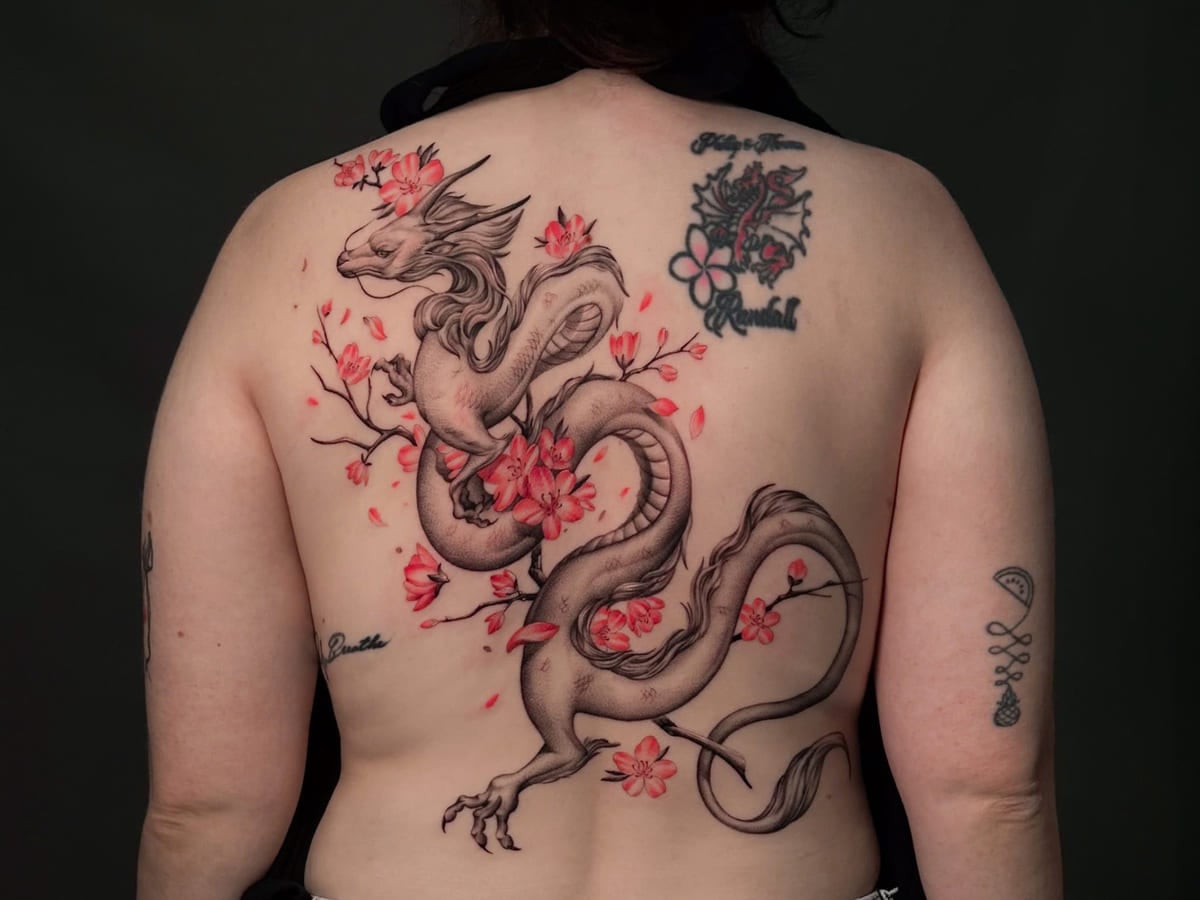
Bold outlines, stylised petals, and the lotus set among waves, koi, dragons or tigers as part of a larger composition. This is the style for anyone planning a sleeve, chest panel or back piece rather than a standalone flower.
In Japanese work the lotus is rarely the subject on its own; it is a supporting element that gives a larger narrative somewhere to breathe. If a full composition interests you, our guide to the lotus and koi fish combination covers how the two elements are composed together.

Blackwork and negative space
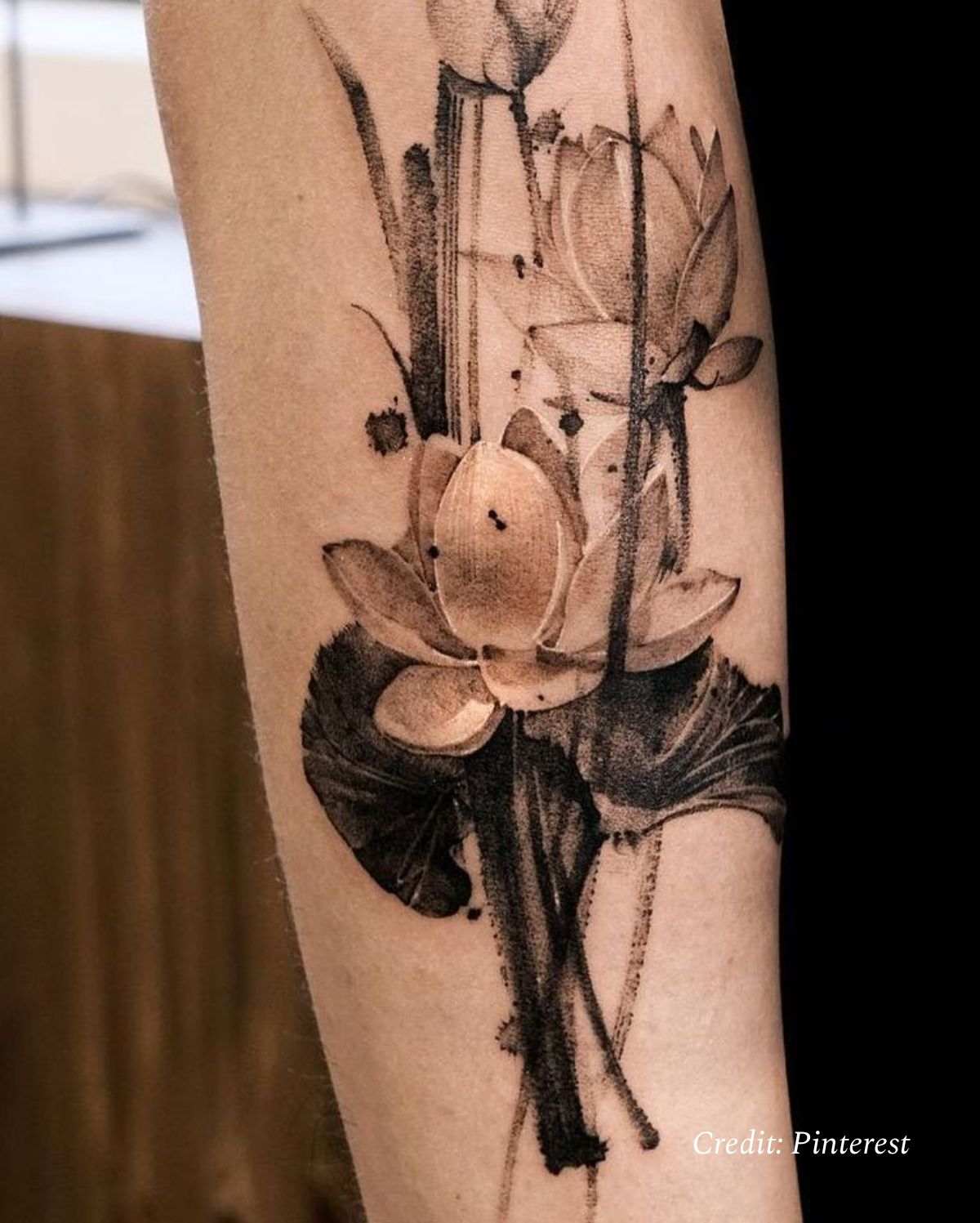
Heavy solid black with the lotus formed by the skin left untouched. The boldest and most durable version, since solid black outlasts any gradient. Suits people who want something that reads clearly from a distance and will look essentially the same in twenty years. See more blackwork examples.
Size Guide
The lotus scales better than most subjects because its structure is repeating petals rather than fine internal detail. The limit is set by how many petal layers you want visible.
| Version | Minimum size | What fails below it |
| Simple outline, single petal layer | 3 to 4 cm | Petal tips merge into one shape |
| Geometric lotus with internal lines | 7 cm | Line junctions close up over the years |
| Layered lotus with shading | 8 to 10 cm | Petal separation flattens |
| Dotwork mandala lotus | 12 cm and up | Dots merge into solid grey |
| Japanese lotus within a composition | 20 cm and up | The flower competes rather than supports |
Dotwork is the version most often undersized. Stippling relies on visible gaps between dots, and those gaps are exactly what closes first as ink settles. If you want dotwork, size up.
Placement
| Placement | Suits | Notes |
| Forearm | Geometric, linework, medium shaded | Flat, visible, easy to heal. The most common choice. |
| Upper arm and shoulder | Mandala, Japanese, larger shaded work | Curved surface suits the radial shape. Comfortable to sit. |
| Centre chest | Symmetrical mandala and geometric lotus | The strongest symbolic placement. Symmetry must be exact, and it is sharper near the sternum. |
| Spine | Vertical stacked lotus or mandala | Striking when aligned correctly. Highest risk placement for symmetry. |
| Back and sleeve | Japanese compositions | Room for the lotus to support a larger narrative. See large-scale work. |
| Calf | Medium geometric or blackwork | Good muscle coverage, straightforward to sit and to heal |
| Wrist or behind the ear | Simple outlines only | Too small for geometry or dotwork |
Getting a Lotus Tattoo in Vietnam
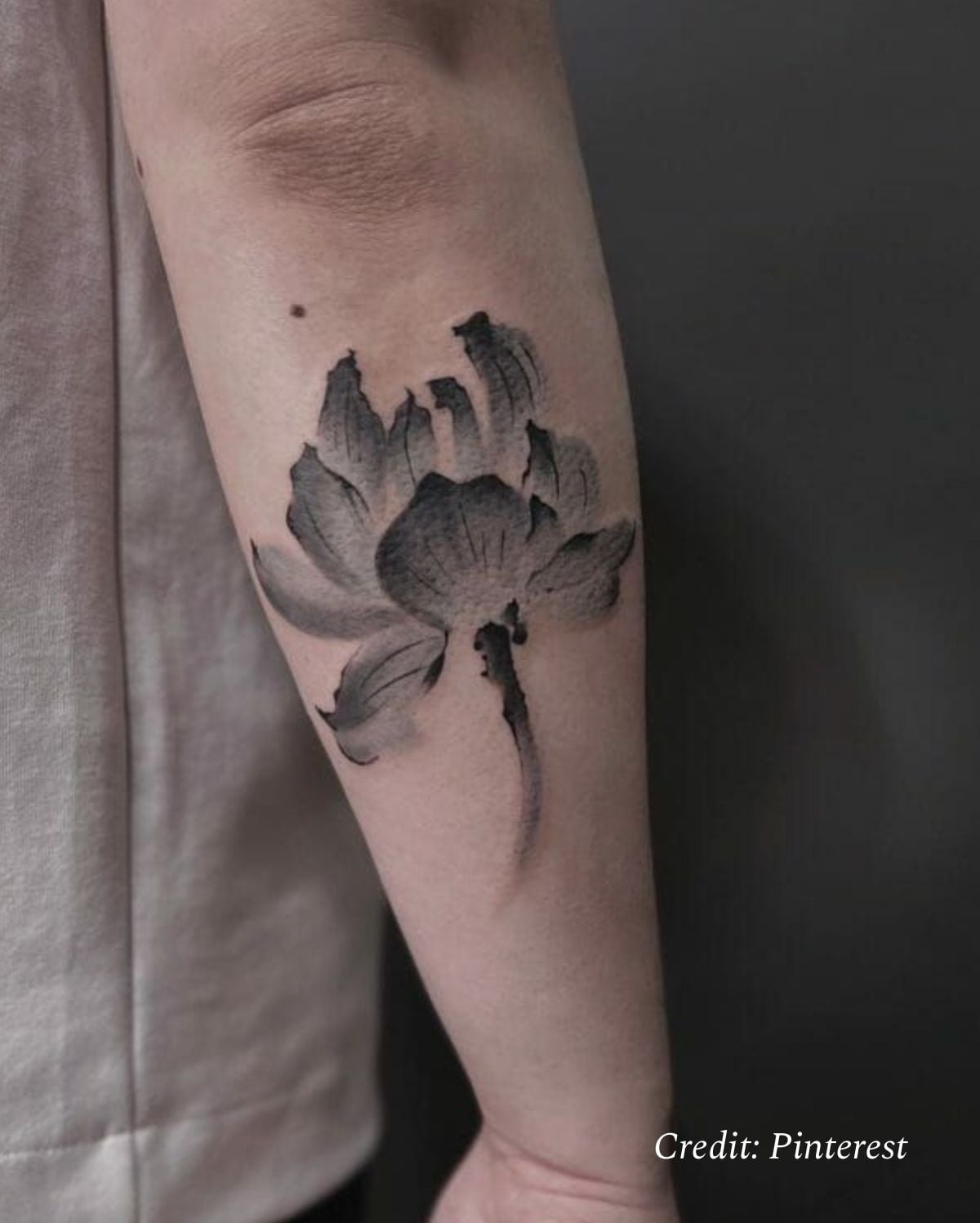
If you are getting this design in Vietnam, one choice is worth raising at consultation: whether you want the flower rendered in a Japanese register or a Vietnamese one. They look noticeably different. Japanese lotus work is stylised, with bold outlines and formalised petal shapes. Vietnamese treatment tends to be softer and more naturalistic, closer to how the flower appears in local traditional motifs and temple carving.
Neither is more authentic than the other, but mixing them without intention is the most common reason a lotus piece looks slightly unresolved. The short film below covers how the lotus is understood and rendered at our Hanoi studio, which is useful if you are weighing up the two approaches.
Choosing an Artist
- Match the artist to the style, not the subject. Geometric and dotwork lotus work and Japanese lotus work are different disciplines. An artist strong in one is not automatically strong in the other.
- Ask to see healed geometric or dotwork. Both styles depend on gaps staying open. A healed photograph at six weeks tells you whether the artist’s spacing survives; a fresh photograph tells you nothing.
- Watch how they handle the stencil. An artist who spends ten minutes repositioning a symmetrical design and asks you to check it standing is doing the job properly.
Lotus Work at OCD Ink Studio
OCD Ink Studio draws every piece around the client’s own idea rather than working from flash, which matters for a symmetrical subject where the design has to be built for your specific placement. Four specifics:
- Artists assigned by specialisation. Geometric, fine line and blackwork lotus work goes to artists in those registers; colour and realism goes to Mike. Founder Dino specialises in graphic and fine line and won Best of Day in the Black & Grey category at the Vietnam Tattoo Convention 2020. See the full team.
- Healed results published openly in our healed gallery, which is the only honest way to judge whether geometric spacing and dotwork gaps hold.
- A two-year touch-up warranty, which covers settling work after healing rather than charging for it.
- Two studios and a complimentary protective film. One in Hanoi’s Old Quarter, one near Hoi An Ancient Town, with English-speaking consultation throughout and a second skin film for the first 72 hours.
Send your reference with a size in centimetres and a placement, or book in Hanoi or book in Hoi An.
FAQs
Is a lotus tattoo masculine?
Its meanings, discipline, composure and growth through difficulty, read as masculine to most people who choose it. Geometric, blackwork and Japanese treatments reinforce that further than a soft naturalistic rendering would.
What does a lotus flower tattoo symbolise?
Purity, rebirth and growth out of difficult conditions, drawn from Buddhist and Hindu symbolism. It is also Vietnam’s national flower, where it carries an additional meaning of integrity and resilience.
Where should a man put a lotus tattoo?
The forearm and upper arm are the most straightforward. The centre chest and spine are the strongest symbolically but demand exact symmetry, so they need an artist who will take time over stencil placement.
How big should a lotus tattoo be?
A simple outline works from 3 to 4 cm. Geometric versions need about 7 cm, shaded layered versions 8 to 10 cm, and dotwork mandalas 12 cm or more so the dots stay separate.
Colour or black and grey?
Most masculine lotus work is black and grey, which suits geometric and blackwork treatments and is more durable. Colour suits Japanese compositions but needs more sun protection, since reds and pinks fade faster than black.
How long does a lotus tattoo take?
A small outline takes under an hour. A geometric forearm piece takes 2 to 4 hours. A dotwork mandala can take 5 to 8 hours or more, because every dot is placed individually. See how long tattoos take.