
A koi fish tattoo symbolises perseverance and transformation through hardship. The meaning comes from the Chinese legend of the Dragon Gate, where a carp that swims upstream and leaps the falls is transformed into a dragon. In Japanese tattooing the koi became a symbol of courage, ambition and good fortune.
This guide covers the legend, what colours are commonly said to mean, the real koi varieties that give you a far more specific brief than “an orange fish”, the styles and combinations that work, and the sizes a koi needs to keep its scales.
The Dragon Gate Legend
In the Chinese story, carp swim up the Yellow River against the current. Most give up. The few that reach the waterfall at the Dragon Gate and leap it are transformed into dragons. The story became shorthand for effort rewarded: in China, passing the imperial examinations was compared to leaping the Dragon Gate.
Japan took the image further. Koi streamers are flown for Children’s Day, and in irezumi (traditional Japanese tattooing) the koi stands for courage, determination and accepting fate calmly. That is why koi so often appear alongside dragons: the dragon is where the koi’s story ends.
Koi Colours and What They Are Associated With
Colour meanings come from tattoo convention rather than any single authority, but they are widely recognised:
| Colour | Commonly associated with | Practical note |
| Black | Overcoming adversity, transformation through struggle | The most durable pigment |
| Red | Strength, love, energy | Fades faster under sun; needs protection |
| Orange | Family, warmth | As red |
| Gold or yellow | Wealth, prosperity | Yellow is among the least stable pigments |
| Blue | Calm, peace, reproduction | Holds reasonably well |
| White | Purity, a clean start | Usually built from bare skin rather than white ink, which fades fast |

Brief Your Artist With a Real Koi Variety
Real koi are bred in named varieties with recognisable patterns. Naming one gives your artist a far more precise reference than a colour, and it makes the tattoo read as a specific fish rather than a generic one.
| Variety | Pattern | Works well as |
| Kohaku | White body with red markings | The classic koi; clean and readable at most sizes |
| Taisho Sanke | White body with red and small black markings | Adds contrast to a Kohaku look |
| Showa | Black base with red and white | High contrast; strong in bold traditional work |
| Tancho | White body with a single red spot on the head | Minimal designs; reads well small |
| Asagi | Blue-grey netted scales with red along the sides | Shows off scale detail; needs size |
| Ogon | A single metallic gold or platinum colour | Gold koi designs; relies on shading for shine |
Two practical points. White areas in Kohaku, Sanke and Tancho patterns are usually created by leaving skin uninked, because white pigment is the least stable ink and yellows over time. And a pattern like Asagi depends on visible scale netting, which sets a firm minimum size.
Styles
Japanese traditional
Bold outlines, stylised scales and the koi set among waves, wind bars and blossoms. The style the koi belongs to historically, and the one built for sleeves and back pieces. See Asian-inspired work.

Colour
Full red, orange and gold koi with saturated shading. The most expressive version and the most maintenance-heavy, since warm pigments fade first. See colour realism.

Black and grey
Scales, fins and water built from shading alone. More durable than colour and well suited to the black koi’s meaning of overcoming adversity. See black and grey work.

Fine line and minimalist
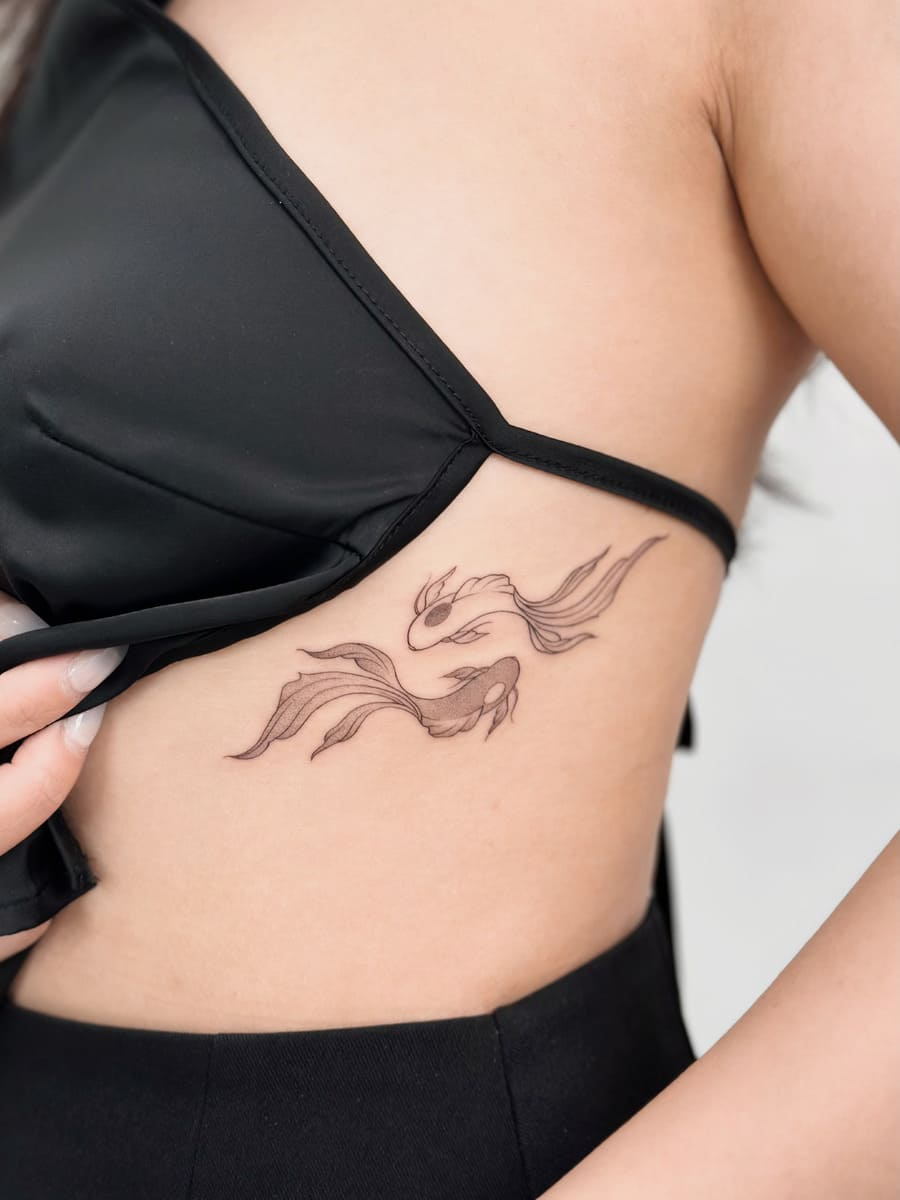
A simplified koi outline, often with a single curve of water. The quickest version and the most popular small travel piece, though it gives up the scale detail entirely. See fine line work.

Combinations
| Combination | Meaning | Design note |
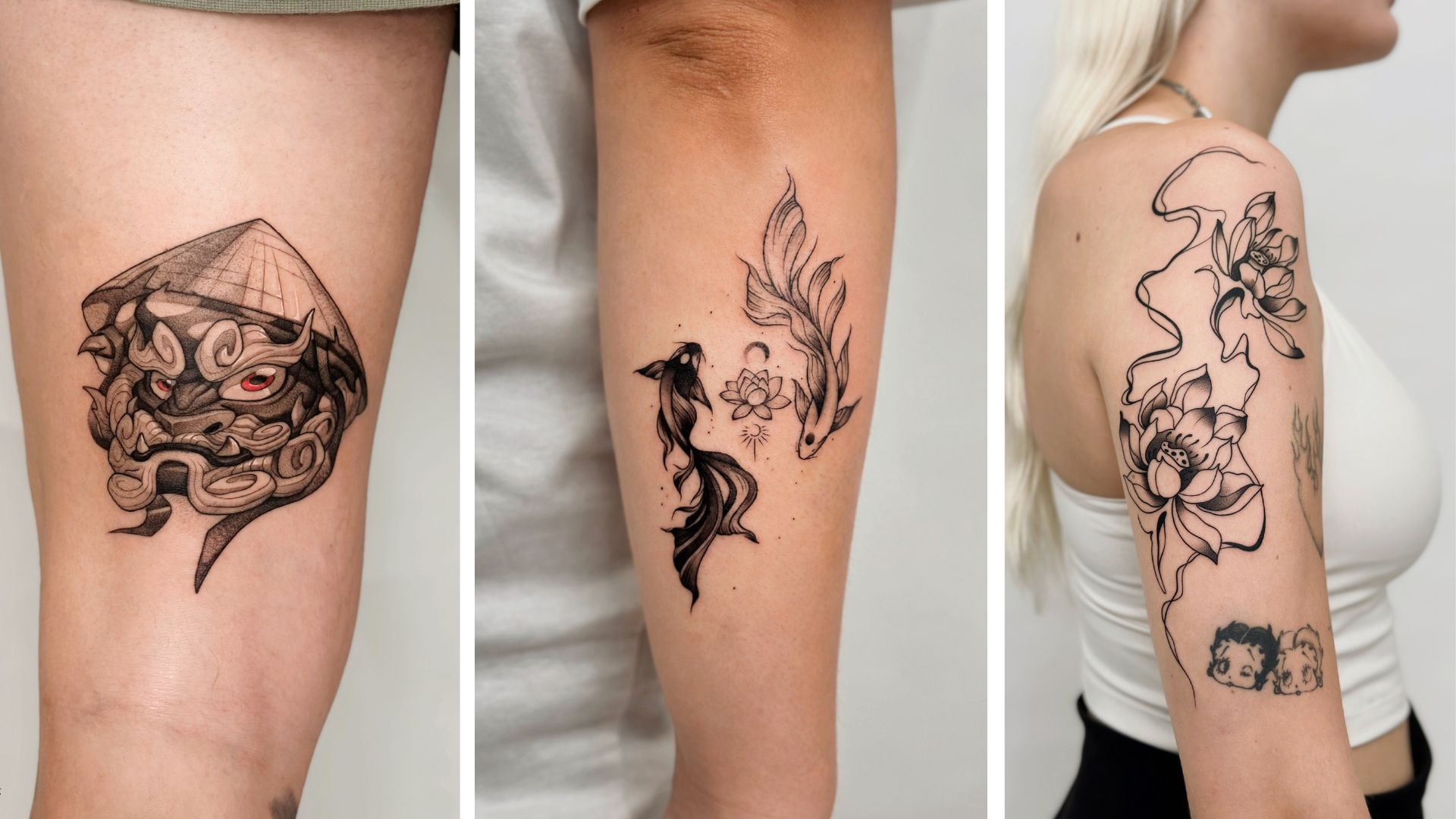
| Two koi (yin-yang) | Balance, partnership; often black and white or red and black | The circle must be exact, so placement needs care |
| Koi and lotus | Struggle followed by clarity | Covered in depth in our lotus and koi guide |
| Koi and waves | Persistence against resistance | The water is structural; it carries the eye on large pieces |
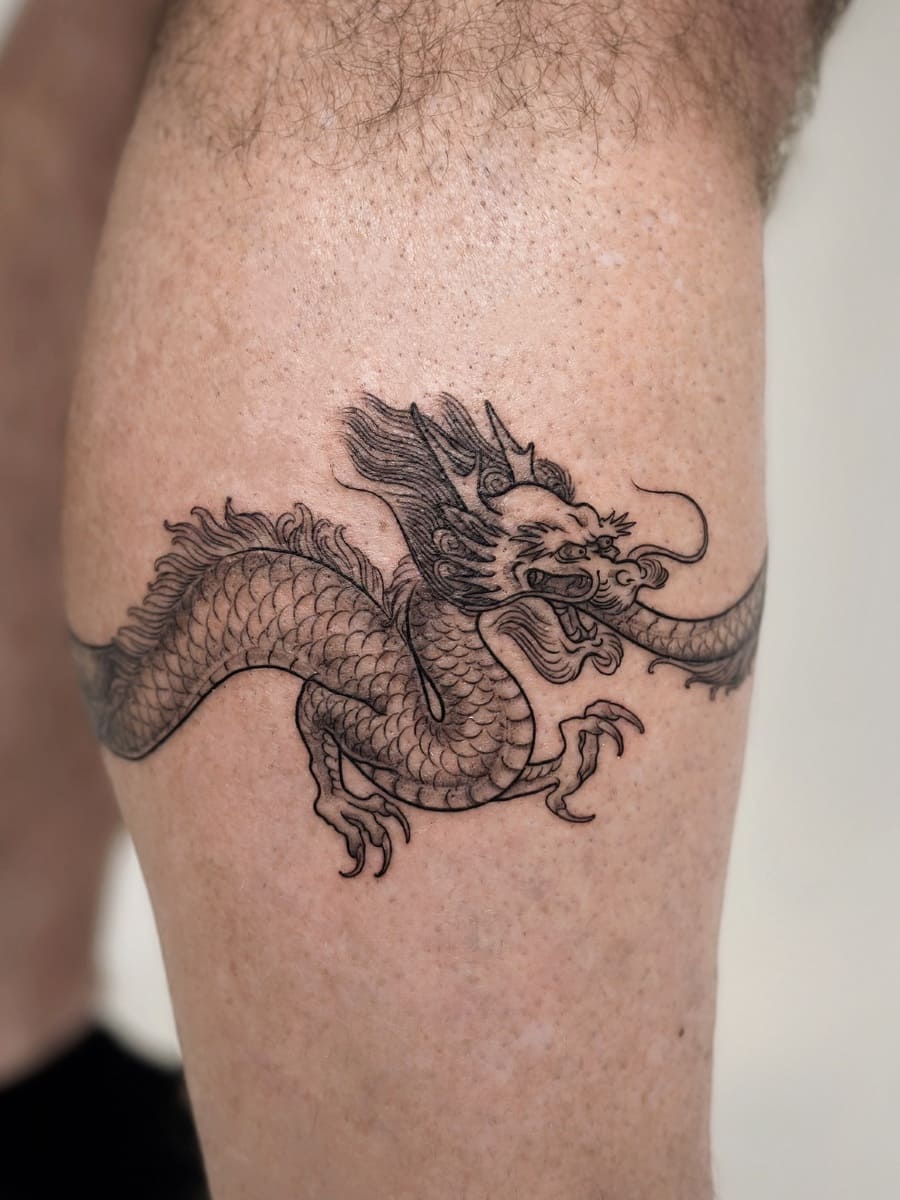
| Koi becoming a dragon | Transformation completed | Needs a sleeve or back to show both stages |
| Koi with cherry blossom | Strength set against impermanence | See cherry blossom meaning |


One detail changes the meaning of any koi: the direction it swims. Upward is commonly read as a struggle still underway, downward as one already overcome. Because direction is read against your body rather than the paper, decide it together with placement. The lotus and koi guide explains why.
How Big Does a Koi Need to Be?
| Version | Minimum size | What fails below it |
| Simple fine line outline | 5 cm | Fins merge into the body |
| Koi with a variety pattern (Kohaku, Tancho) | 8 cm | Markings lose their shape |
| Koi with visible scales | 12 cm | Scales close into a solid tone |
| Koi with water or lotus | 15 cm | Elements compete for space |
| Traditional composition | Sleeve or back |
Ink settles very slightly into surrounding skin as the years pass, and dense, repeating detail like scales is the first thing to soften. If the space is small, choose a simplified koi rather than a shrunken detailed one.
Placement
| Placement | Suits | Notes |
| Sleeve | Traditional koi with water | The classic placement; water wraps the arm. See large-scale work. |
| Back | Koi-to-dragon compositions | Room to tell the whole story |
| Forearm | Single koi, medium size | The limb suits a directional fish; decide up or down deliberately |
| Thigh and calf | Colour or realism koi | Spacious, comfortable, naturally sun-protected |
| Chest | Paired or yin-yang koi | Symmetry suits two fish |
| Wrist or ankle | Simplified outline only | Too small for scales or patterns |
Choosing an Artist for a Koi
- Ask for healed scale work. Scales are the hardest part and the first to fail. Healed photos at six weeks show whether they held.
- Match colour to the colour specialist. Warm, saturated koi and black and grey koi are different technical jobs.
- Bring a variety name or photo of a real koi. It gives you a far better result than a generic reference from a search engine.
Koi Tattoos at OCD Ink Studio
OCD Ink Studio designs every koi around the client’s chosen variety, direction and placement rather than working from flash. Four specifics:
- Artists assigned by style. Colour and realism koi go to Mike; traditional and neo-traditional to Pillo and Sulley, who won Best Collaboration at the Saigon Tattoo Expo 2025; fine line koi to our fine line specialists. Founder Dino won Best of Day in the Black & Grey category at the Vietnam Tattoo Convention 2020. Full team on the artist page.
- Healed results published openly in our healed gallery, where colour and scale work can be judged once settled.
- A two-year touch-up warranty, relevant for red, orange and gold koi.
- Two studios on the travel route, in Hanoi and Hoi An, with English-speaking consultation and a complimentary protective film for the first 72 hours.
Send your references with a variety, size in centimetres and placement, or book in Hanoi or book in Hoi An.
FAQs
What does a koi fish tattoo mean?
Perseverance and transformation through hardship, from the legend of the carp that leaps the Dragon Gate and becomes a dragon. In Japanese tattooing it also stands for courage and good fortune.
What do koi colours mean?
By convention, black for overcoming adversity, red for strength and love, orange for family, gold for prosperity and blue for calm. These are tattoo associations rather than fixed rules.
Which way should my koi swim?
Upward is commonly read as a struggle in progress, downward as one overcome. Decide it with your placement, because direction is read relative to your body.
How small can a koi tattoo be?
About 5 cm for a simple outline, 8 cm for a variety pattern, and 12 cm or more if you want visible scales.
Colour or black and grey?
Colour is traditional and expressive but needs more sun protection. Black and grey is more durable and suits the black koi’s meaning well.
How long does a koi tattoo take?
A small outline takes under 2 hours. A detailed forearm koi takes 3 to 5 hours. A sleeve runs across several sessions. See how long tattoos take.