Wolf Tattoos: Meaning, Styles and How to Keep the Face Readable
A wolf tattoo carries two readings that pull in opposite directions: the lone wolf for independence and self-reliance, and the pack for loyalty and family. Deciding which one you mean changes the composition entirely, and it is the first question worth answering.
The second question is technical. A wolf is recognisable almost entirely through its face: the eyes, the muzzle, the ear set. Those are the first details to soften as a tattoo ages, which is why undersized wolf tattoos drift toward looking like a generic dog. This guide covers the symbolism, the four style approaches, and the sizes each one needs.
Lone Wolf or Pack?
| Reading | Means | Composition it implies |
| Lone wolf | Independence, self-reliance, walking your own path | A single head or full figure, isolated, with space around it |
| The pack | Loyalty, family, community, protecting your own | Multiple wolves, or one wolf with family names, dates or a landscape |
| Howling wolf | Instinct, intuition, calling to something distant | Profile against a moon; the moon gives the composition its anchor |
| Guardian wolf | Protection, watchfulness | Front-facing stare, usually chest or back placement |
The front-facing wolf and the profile wolf are not interchangeable. A front-facing stare reads as confrontation and protection, and demands a symmetrical placement such as the chest or centre back. A profile reads as movement and introspection, and sits naturally on a forearm or calf where the limb’s line carries it. Choose the angle with the placement, not before it.
The Face Problem
Everything that makes a wolf a wolf rather than a dog lives in a small area: the narrow muzzle, the set and angle of the eyes, the triangular ears, and the ruff of fur around the neck. Those are fine-detail features.
Tattoo ink spreads very slightly in the skin over the years. On a large piece this is invisible. On a small wolf head it softens exactly the features that carry the identification, and the result drifts toward a generic canine. This is the most common disappointment with this subject and it is entirely a sizing decision.
| Version | Minimum size | What is lost below it |
| Geometric or blackwork silhouette | 5 cm | Nothing: the outline carries it |
| Fine line profile head | 8 cm | Muzzle and ear definition |
| Shaded wolf head with fur texture | 12 cm | Fur reads as grey mass, not texture |
| Realism wolf head | 15 cm and up | Eyes lose depth; the piece stops reading as a specific animal |
| Full-body wolf with landscape | 20 cm and up | Body and background compete |
The practical rule: if the space is small, choose a silhouette or geometric treatment rather than shrinking a realistic wolf. A bold 5 cm silhouette will still be a wolf in twenty years. A 5 cm realism attempt will not.
Four Style Approaches
Realism
Fur texture, eye depth, shadow and expression. The most demanding version of this subject, because fur is built from thousands of directional strokes and the eyes have to carry the whole piece. Needs a realism specialist and real scale.
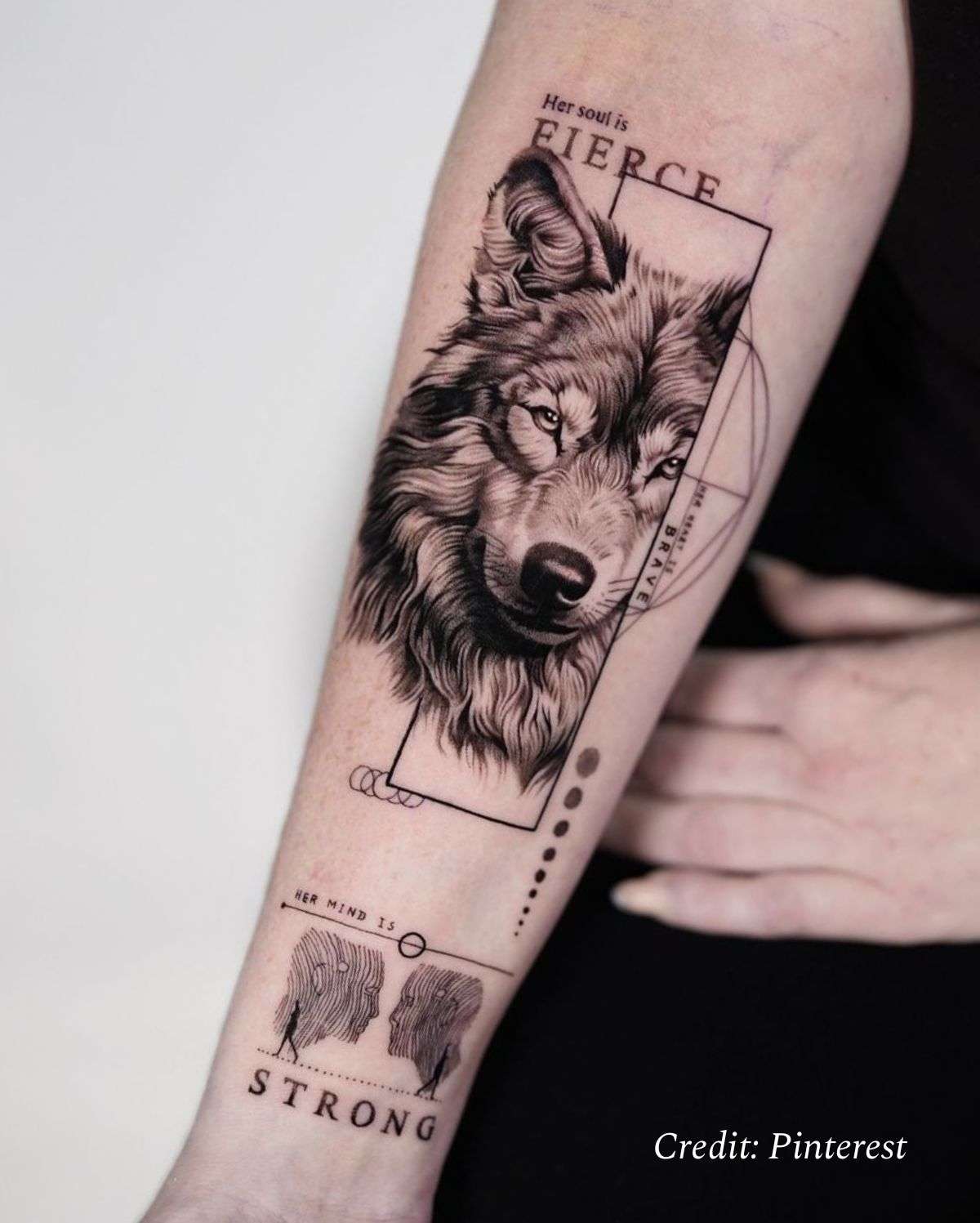
One decision to make early: colour or black and grey. Wolves are naturally grey-toned, so black and grey is both the obvious choice and the more durable one. Colour realism wolves exist and look striking, but they carry the maintenance cost that all colour work does.
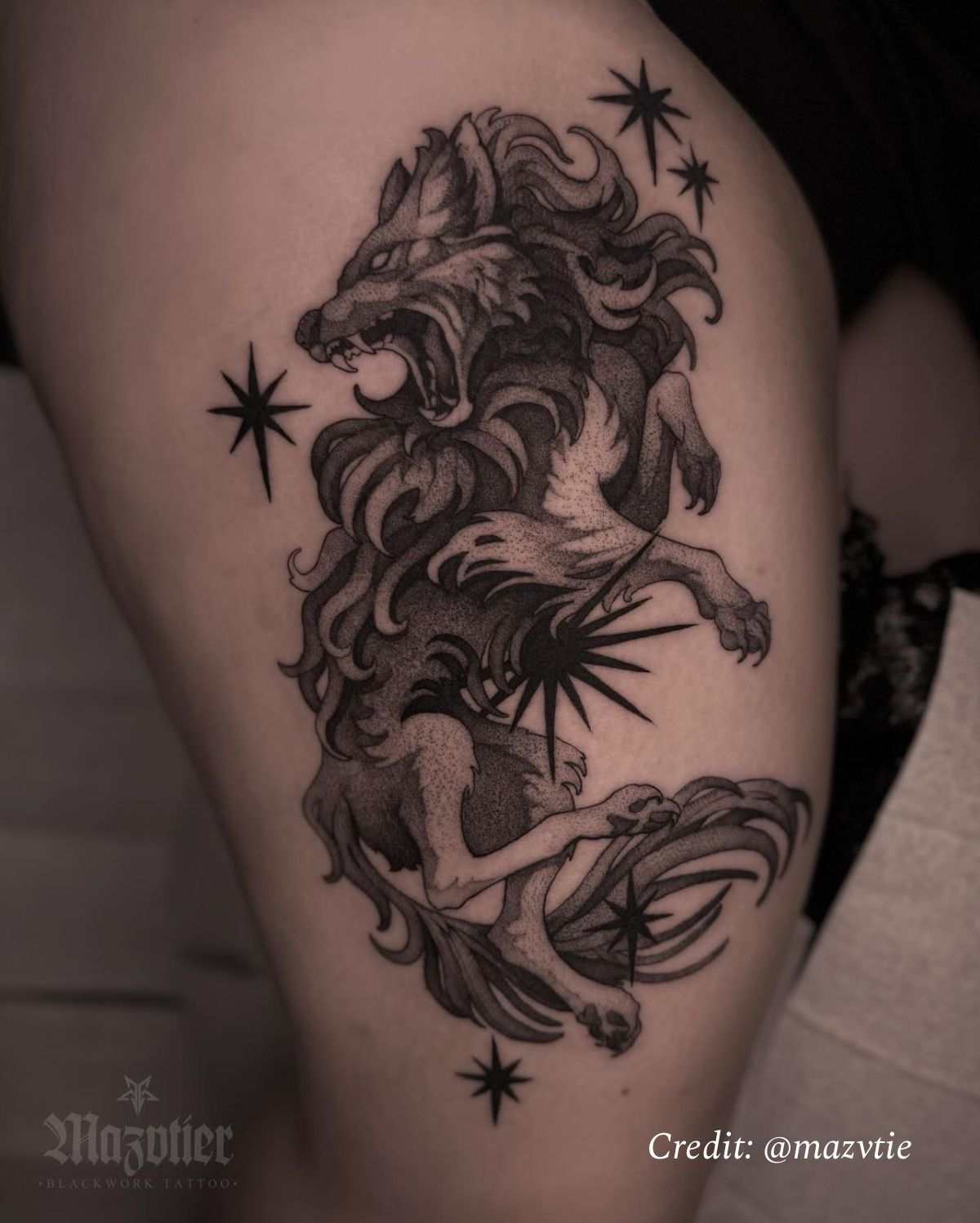
Blackwork and geometric
Solid black, high contrast, no shading. Form carried by silhouette and negative space rather than detail. This is the most durable construction in tattooing and the version that works at the smallest sizes.
It also suits the subject conceptually: a wolf reduced to its outline keeps the animal’s severity without the softening effect that detailed fur can bring. See more blackwork examples.
Neo-traditional
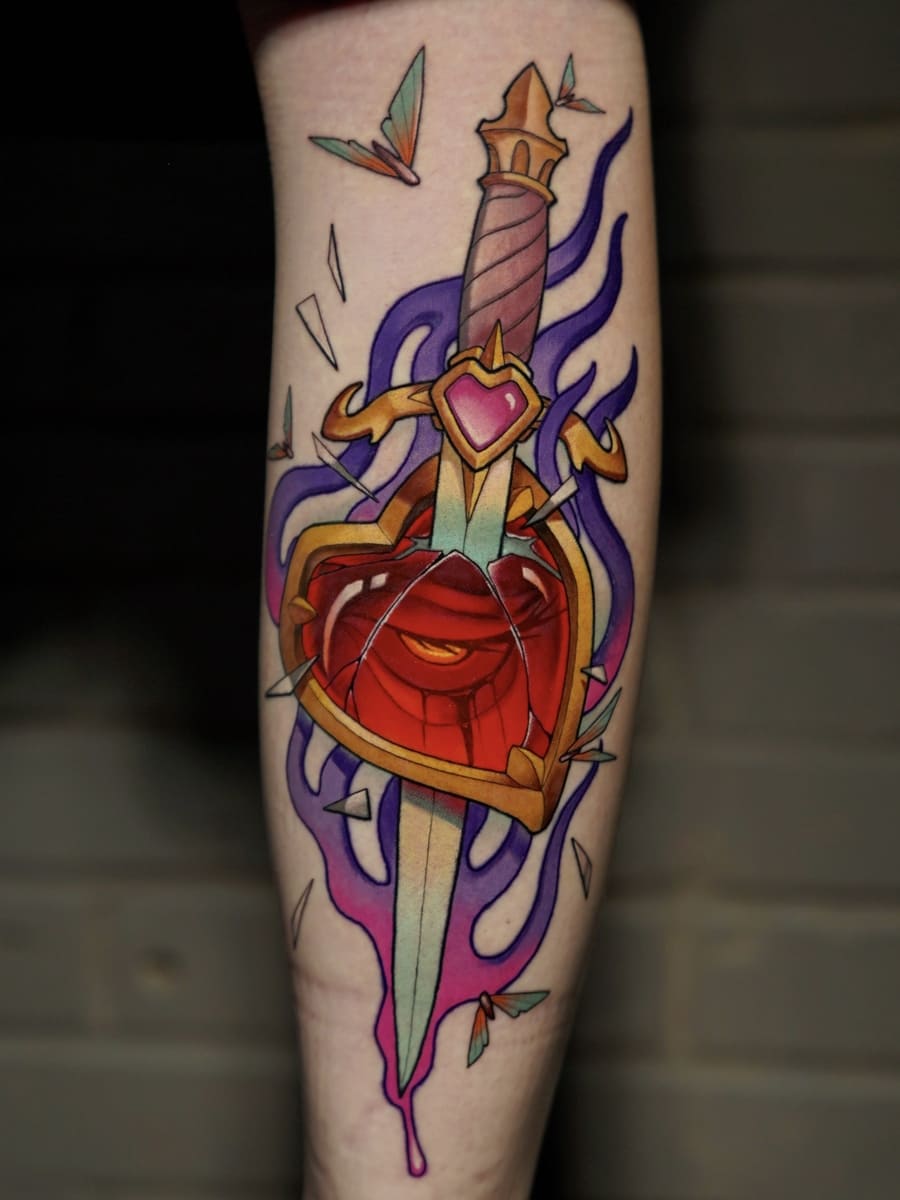
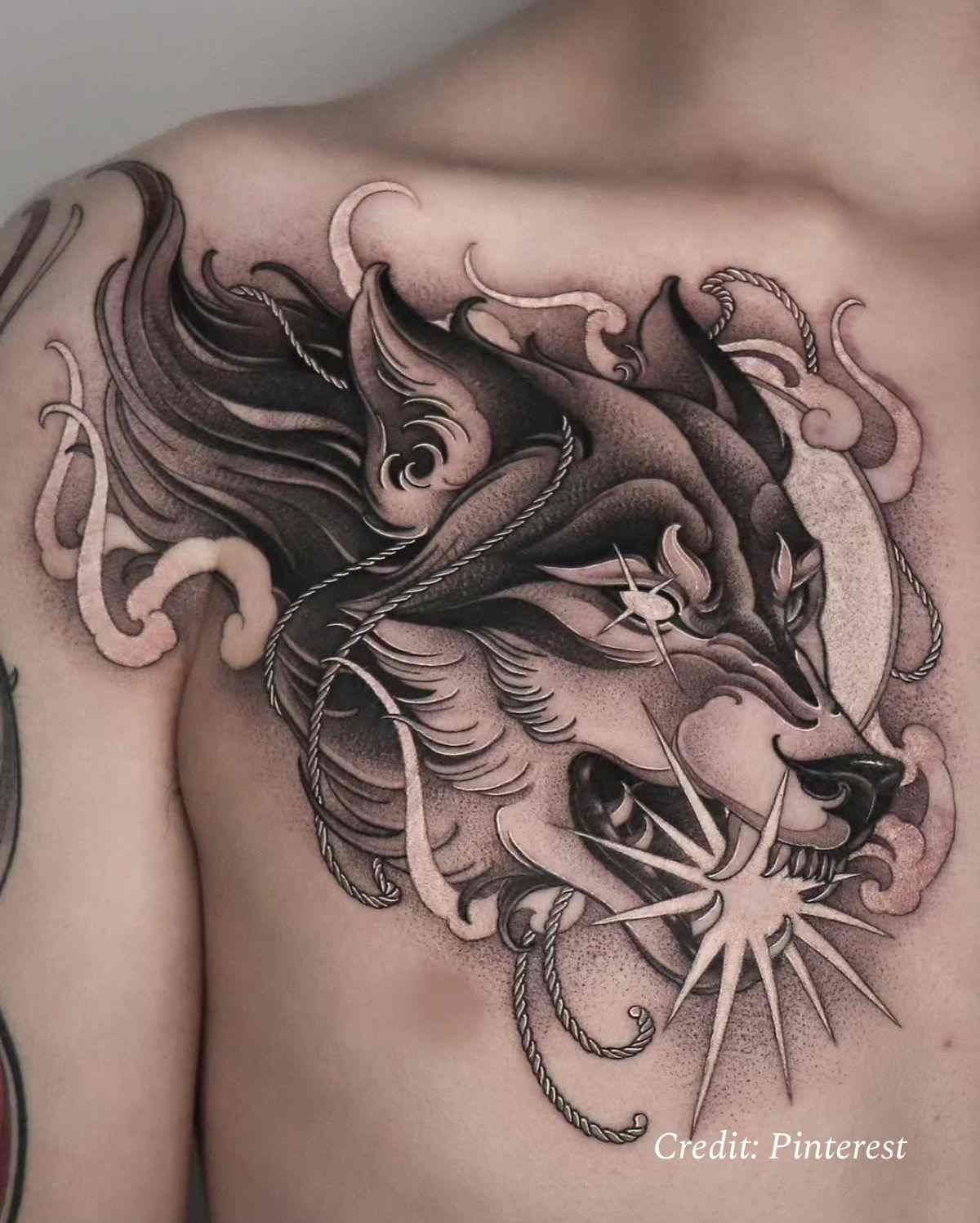
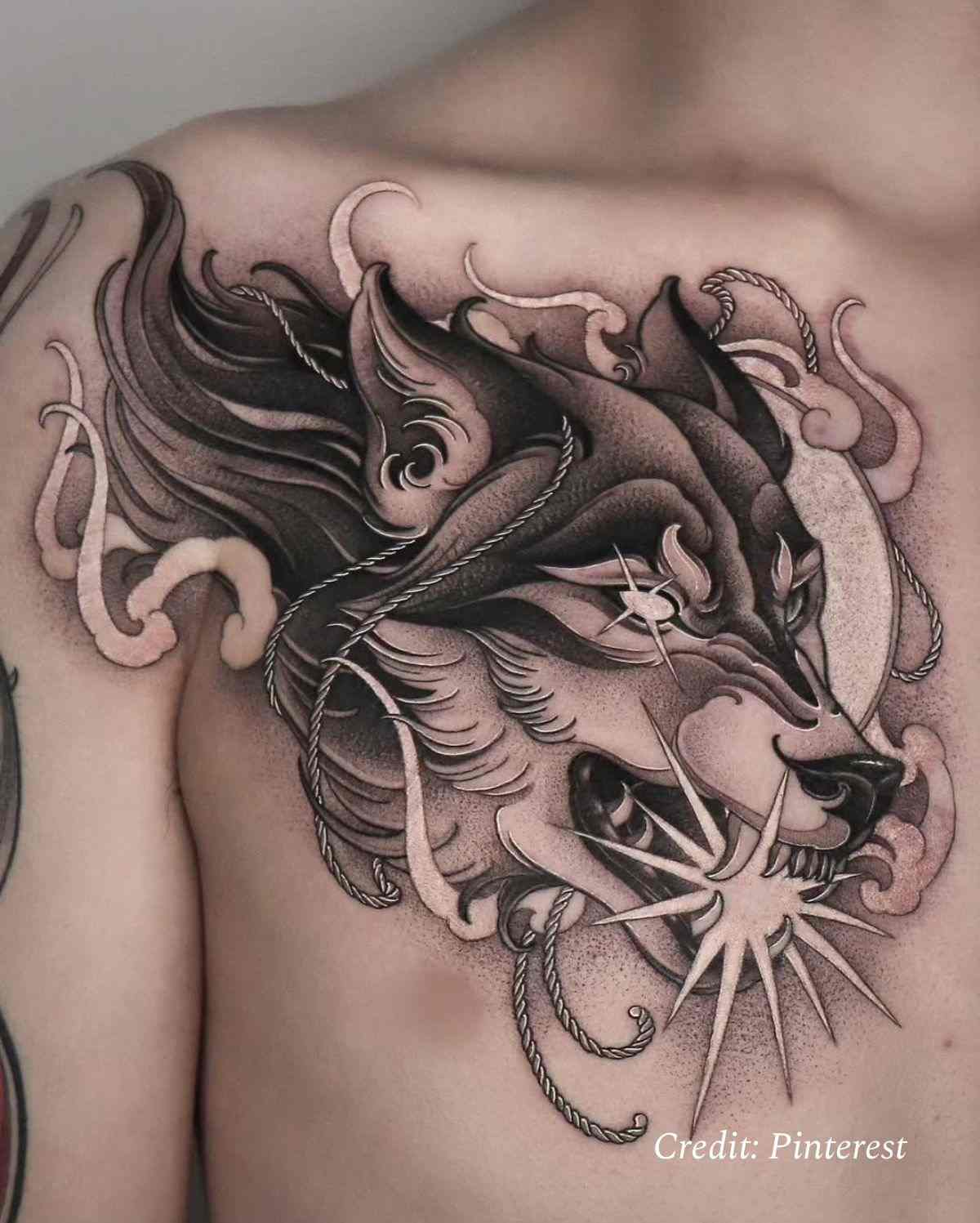
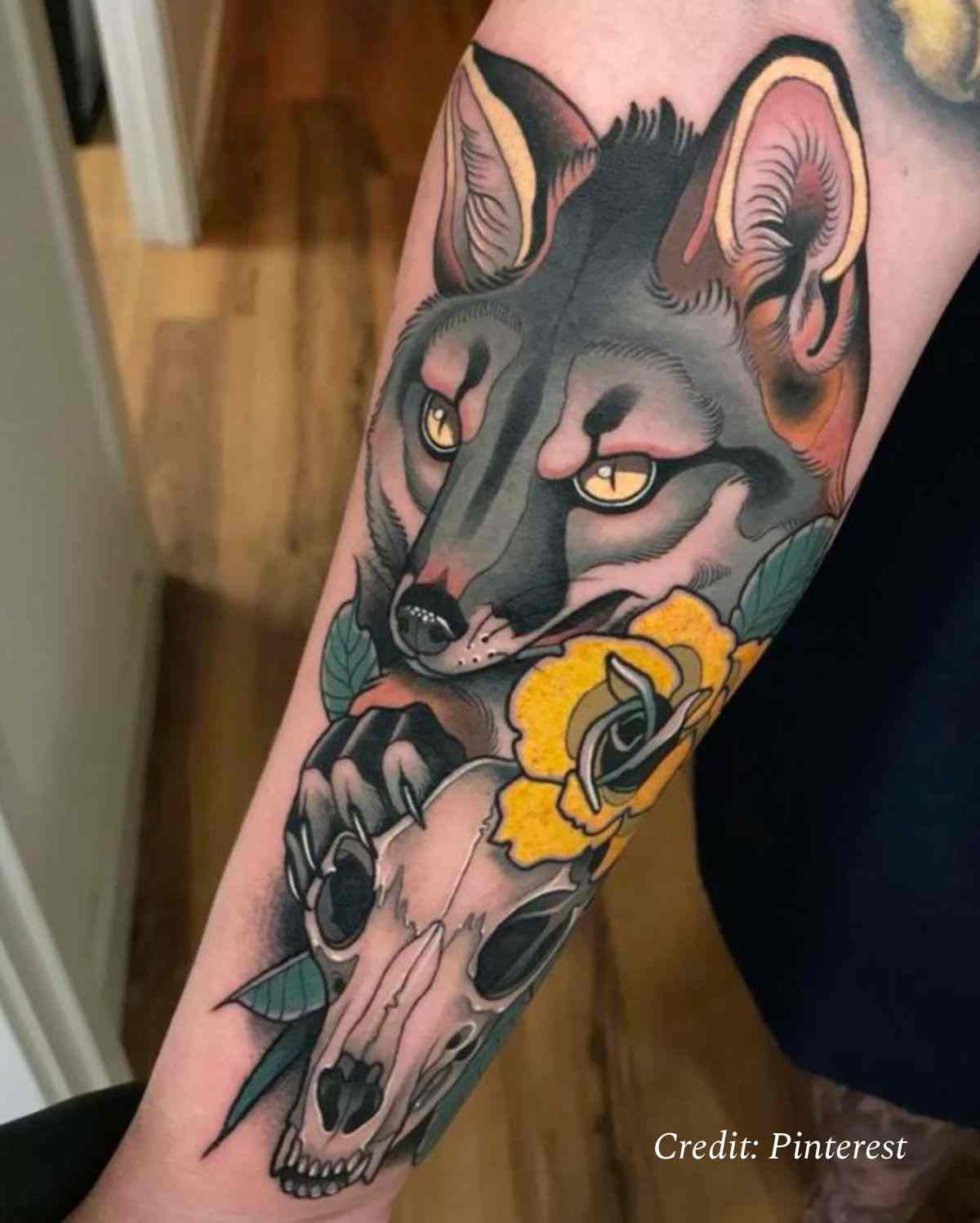
Bold outlines with illustrative shading and a restrained colour palette, often with decorative elements: flowers, daggers, moons or jewels framing the animal. Expressive and story-driven, and structurally durable because the outline holds the shape as colours settle. See traditional and neo-traditional work.
Wolf with elements
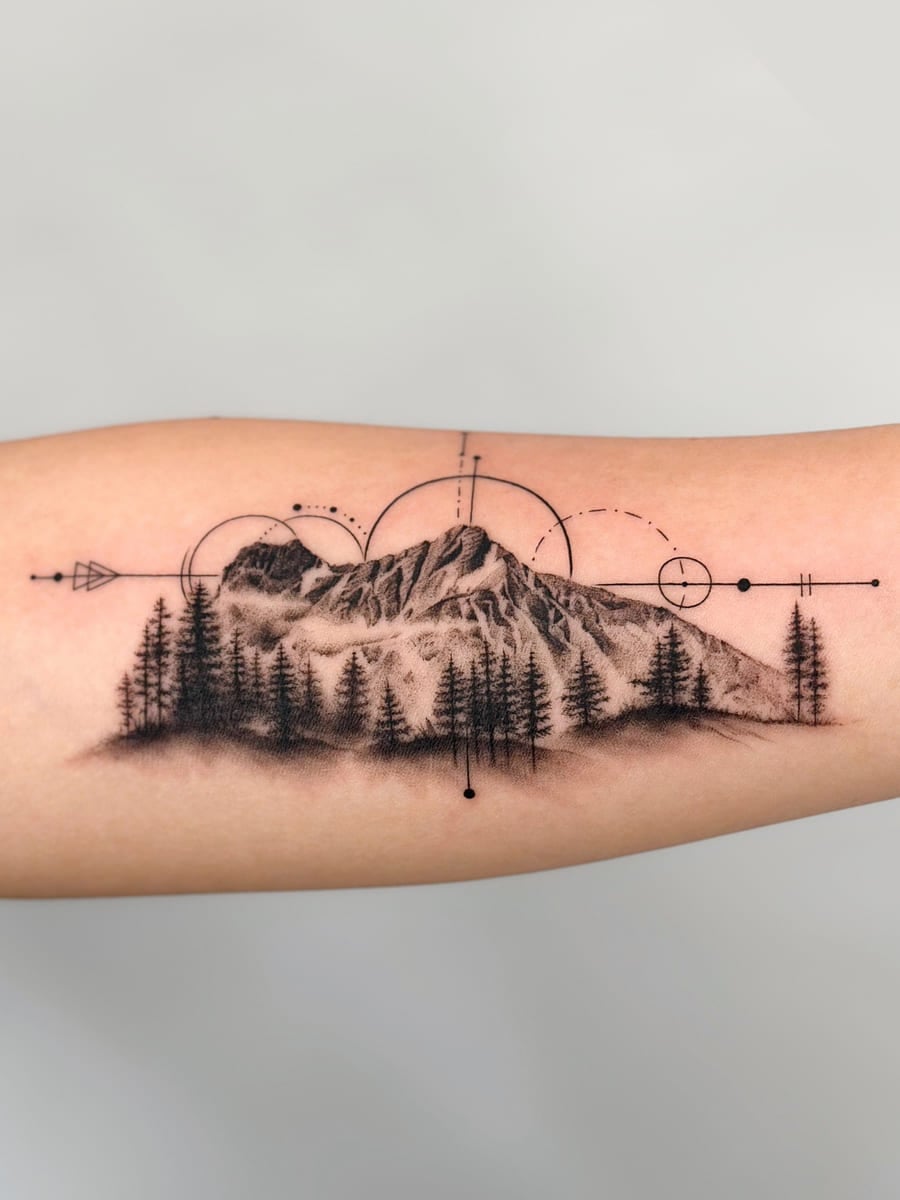
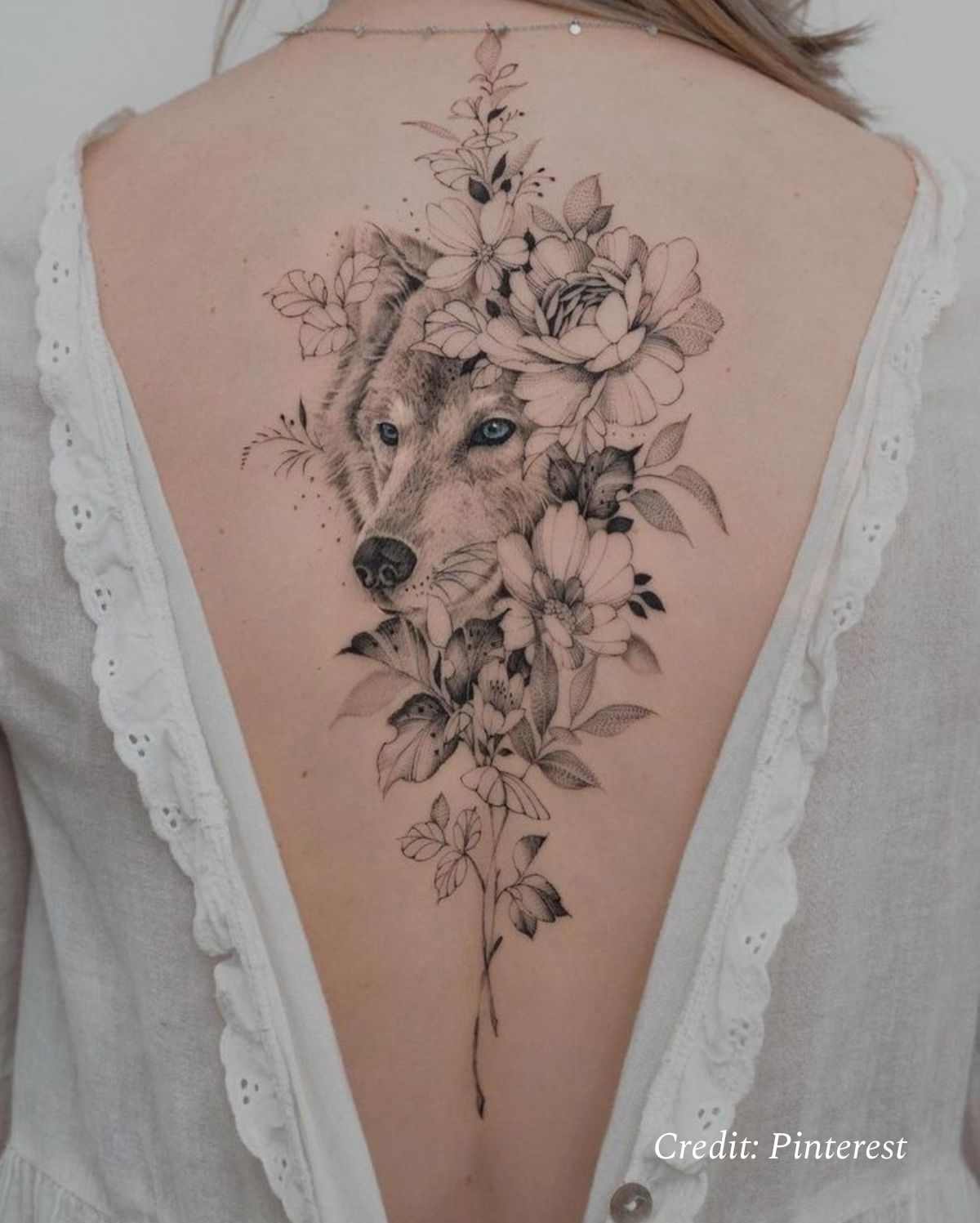
A moon for intuition, mountains or forest for journey and survival, a compass or arrow for self-direction. Each addition sharpens the meaning, and a supporting element also solves a composition problem: a wolf head alone on a large flat area can float, while a moon or treeline anchors it.
The limit worth respecting is hierarchy. Mountains rendered at the same detail level as the wolf will compete with it. Keep the background simpler than the animal, or the eye has nowhere to land. Our illustration work shows how multi-element pieces are balanced.
Placement
| Placement | Suits | Notes |
| Upper arm and shoulder | Realism head, neo-traditional | The most common placement. Comfortable, enough space, easy to cover. |
| Forearm | Profile head, geometric, medium pieces | The limb’s line suits a profile. High sun exposure, so consistent SPF. |
| Chest | Front-facing guardian wolf | Symmetry suits a direct stare. Sharper near the sternum. |
| Back | Full-body wolf, landscape scenes | The widest canvas. See large-scale work. |
| Calf and thigh | Medium realism, blackwork | Comfortable to sit, good muscle coverage, naturally sun-protected |
| Wrist, ankle, behind the ear | Geometric silhouettes only | Too small for any facial detail |

What a Large Animal Piece Actually Involves
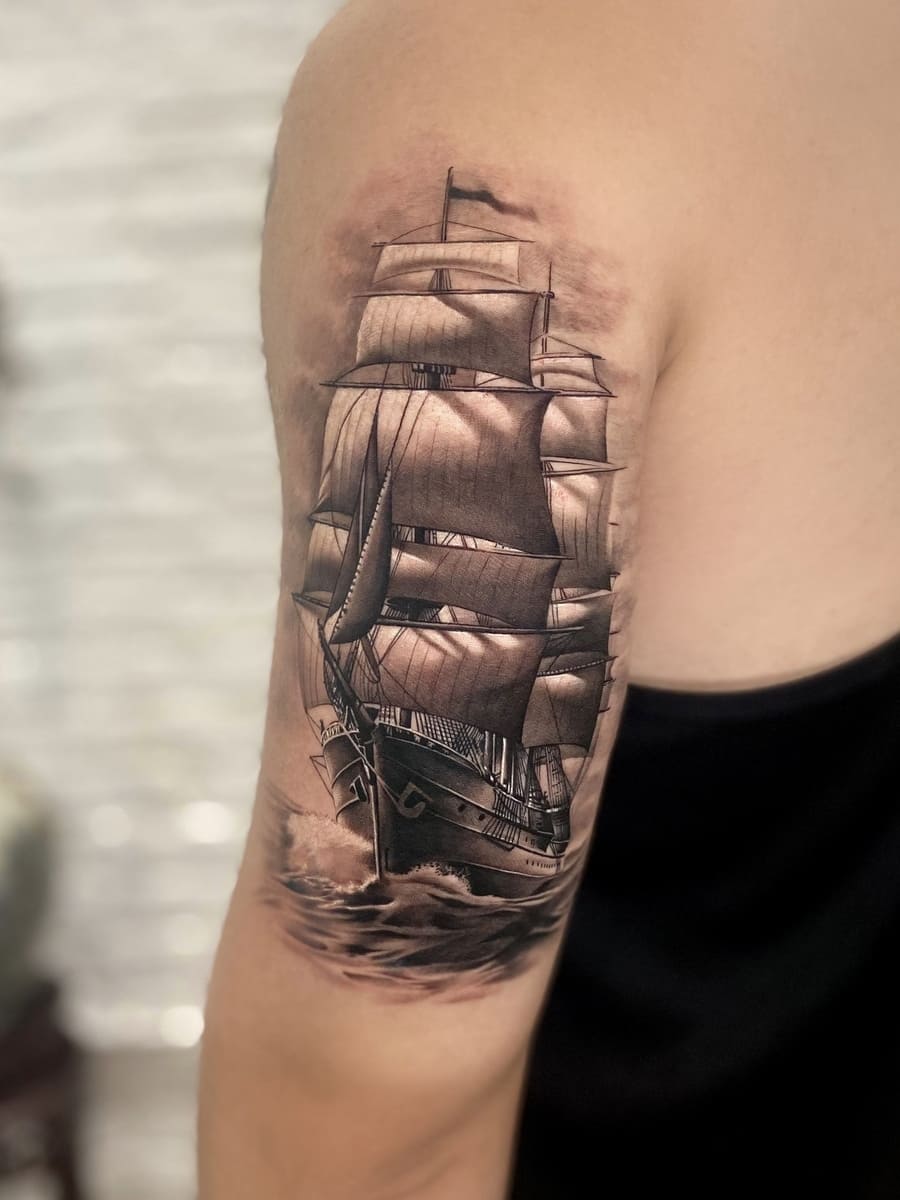
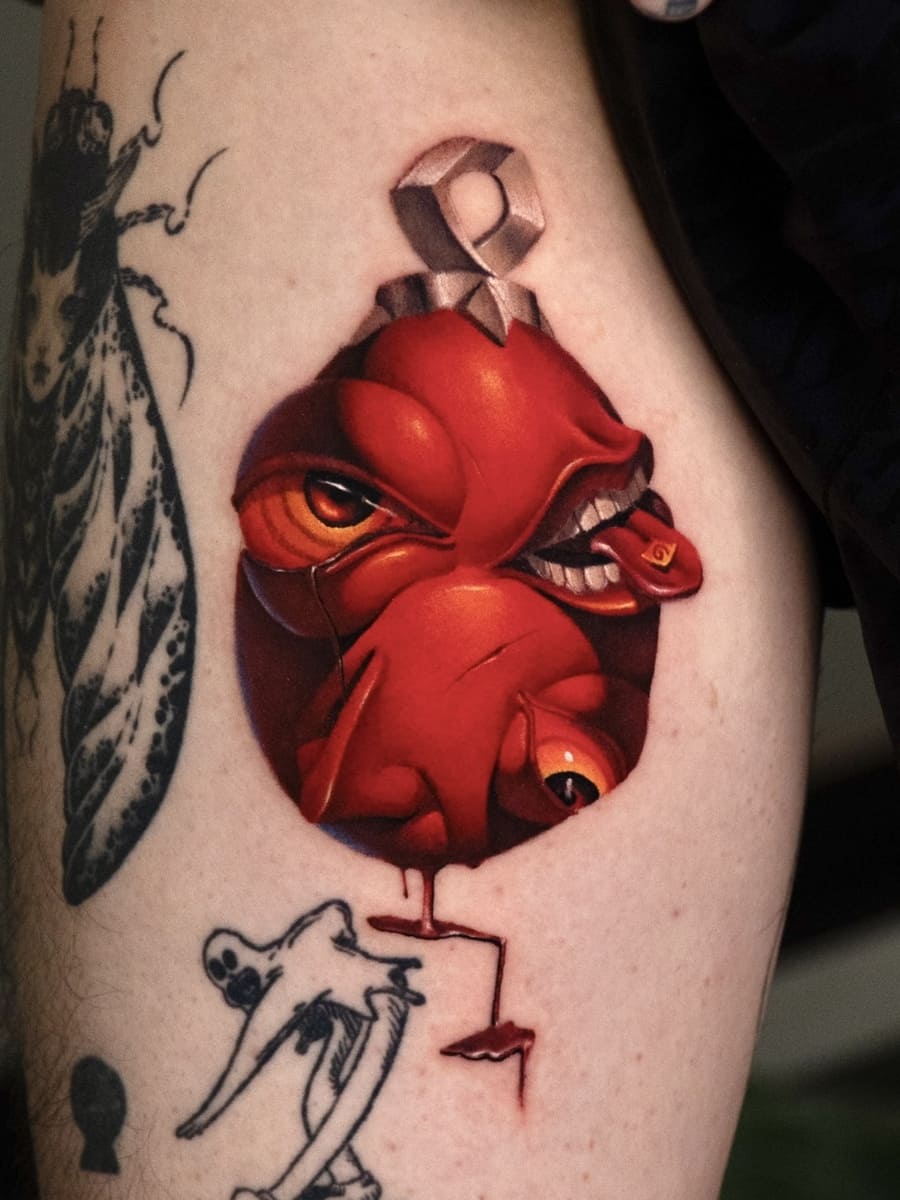
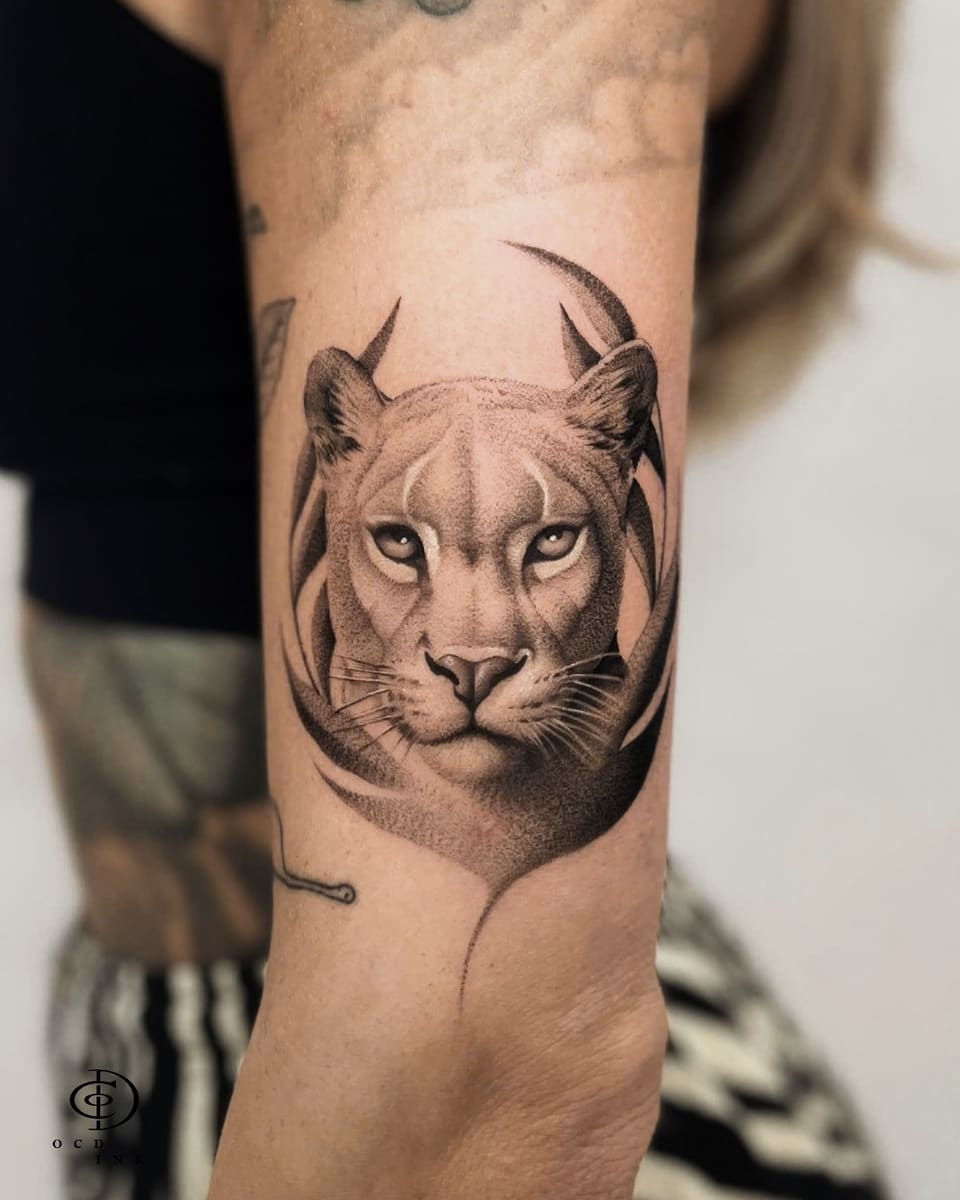
Realistic animal work at scale is one of the largest commitments in tattooing, and the design time is usually invisible to clients until they see it broken down. The piece below, a large custom animal design by our artist Sulley, took 15 hours of design work before 10 hours of tattooing. That ratio is normal for this kind of work, and it is the difference between a custom piece and a traced reference.
Choosing an Artist
- Ask for healed animal work, not fresh. Fur and eyes are where a wolf succeeds, and both look excellent on day one regardless of technique. At six weeks you can see whether the fur still reads as texture or has closed into grey.
- Look specifically at eyes. They are the hardest element in any animal portrait. An artist whose portfolio has consistently convincing eyes is one who can handle this subject.
- Match the style, not the subject. A geometric blackwork specialist and a realism specialist will both say they can do a wolf, and both will be right about different wolves.
- Expect a sketch. A large animal piece designed for your specific placement should go through sketch and revision before any stencil.
Wolf Tattoos at OCD Ink Studio
OCD Ink Studio designs animal work from the client’s own reference and body rather than from flash, and sends the sketch for review before the stencil. Four specifics:
- Artists assigned by specialisation. Realism and colour animal work goes to Mike, a colour and realism specialist; Sulley works in neo-traditional and realism and won Best Collaboration at the Saigon Tattoo Expo 2025; blackwork and geometric treatments go to artists in those registers. Full team on the artist page.
- Healed results published openly in our healed gallery, which is where fur texture and eye depth can honestly be judged.
- A two-year touch-up warranty, relevant for large shaded work where a highlight occasionally wants refreshing after healing.
- Two studios and a complimentary protective film. One in Hanoi’s Old Quarter, one near Hoi An Ancient Town, with English-speaking consultation and a second skin film for the first 72 hours.
Large pieces are quoted per session. If you are travelling on a fixed timeline, tell us how many days you have and we will scope a design that can be completed and healed within it. Send your references, or book in Hanoi or book in Hoi An.
FAQs
What does a wolf tattoo mean?
Loyalty and family when shown as a pack, independence and self-reliance when shown alone. A howling wolf adds intuition and instinct; a front-facing wolf adds protection.
How big does a wolf tattoo need to be?
A geometric silhouette works from about 5 cm. A fine line profile head needs 8 cm, a shaded head 12 cm, and realism 15 cm or more so the eyes and fur stay readable.
Colour or black and grey?
Black and grey suits the subject naturally and is more durable. Colour wolves look striking but need more sun protection, since coloured pigments break down faster than black.
Can a small wolf tattoo work?
Yes, as a silhouette or geometric design. A small realistic wolf head is the version that disappoints, because the facial detail that identifies it as a wolf is the first thing to soften.
How long does a wolf tattoo take?
A small blackwork silhouette takes 1 to 2 hours. A shaded head takes 4 to 6 hours. A realism piece with background commonly needs multiple sessions. See how long tattoos take.
What should I add to a wolf tattoo?
A moon, mountains, forest or a compass all sharpen the meaning and anchor the composition. Keep the supporting element simpler than the wolf so it does not compete for attention.